
Updated: November 15, 2026
A fair leak repair quote names the spot that is leaking, says what will be rebuilt there, and prices each piece. Below are the line items you should expect, with published 2026 ranges for each, and the exact permit fee rates Miami-Dade County charges.
About these numbers. They are published ranges from national cost guides and the county’s official fee schedule, cited at the end. They are not our price list. Miami-Dade is a High-Velocity Hurricane Zone, so code-approved materials and fastening usually put local jobs in the upper half of a national range (why roofs cost more in Miami). Use them to check any quote you get, including ours.
The short answer
Fixr’s 2026 data puts the national average roof leak repair at $800, with most jobs between $350 and $1,500. A minor fix can be as little as $100. Structural damage can go past $8,000 (Fixr, roof leaks).
Two things move the number most: where the water gets in and what the roof is made of.
Cost by where the leak is
Most leaks start where the roof is interrupted, not in the open field (five common leak points). Fixr’s 2026 ranges by location:
| Leak location | Typical repair cost |
|---|---|
| Clogged gutters (overflow backing up under the roof edge) | $100 – $250 |
| Damaged vent or pipe boot | $100 – $600 |
| Missing or damaged shingles | $150 – $450 |
| Nail pops | $200 – $500 |
| Damaged flashing (wall, parapet, step) | $200 – $600 |
| Skylight leak | $300 – $800 (up to $2,800 to replace the skylight) |
| Valley leak | $300 – $1,500 |
| Chimney leak | $200 – $3,500 |
Source: Fixr, roof leaks.
Cost by roof type
Most Miami homes have concrete tile, clay tile, a flat section, or some mix of the three. Fixr splits each material into minor and major leaks:
| Roof type | Minor leak | Major leak |
|---|---|---|
| Asphalt shingle | $150 – $800 | $800 – $2,500 |
| Architectural shingle | $200 – $900 | $900 – $3,000 |
| Flat (TPO, modified bitumen) | $150 – $1,000 | $1,000 – $4,000 |
| Metal | $300 – $1,500 | $1,500 – $4,000 |
| Concrete tile | $450 – $1,500 | $1,500 – $7,000 |
| Clay tile | $500 – $1,800 | $1,800 – $8,000 |
Source: Fixr, roof leaks.
Tile costs more to repair because the tile itself rarely causes the leak. The water gets past the tile and the underlayment beneath it fails. To fix that, the tiles over the leak are lifted and stacked, the underlayment and any wet decking are replaced, and the tiles are set back with code-approved fastening or adhesive. See why tile roofs leak and lift-and-relay vs. replacement.
The line items on a written quote
These are the lines a complete repair quote should show, with a published range for each one:
| Line item | What it covers | Published 2026 range |
|---|---|---|
| Inspection and leak diagnosis | Finding the entry point, which is often feet away from the ceiling stain | A stand-alone roof inspection averages about $430 (Fixr) |
| Labor | Crew time on the roof | $50 – $120 per hour, about 60% of a typical repair bill (Fixr) |
| Flashing reseal | Cleaning and resealing existing flashing | $10 – $25 per linear foot (Modernize) |
| Flashing partial replacement | New metal at a wall, parapet or penetration | $20 – $45 per linear foot (Modernize) |
| Flashing full replacement | Includes removing and resetting roofing around it | $40 – $80+ per linear foot (Modernize) |
| Tile repair (clay or concrete) | Lifting tiles, new underlayment, resetting | $500 – $2,500 (Fixr) |
| Flat-roof repair | Patch or section of membrane | $300 – $1,100 (Fixr) |
| Decking (sheathing) replacement | Rotted plywood under the leak | $150 – $1,000 (Fixr) |
| Emergency or after-hours service | Same-day or next-day response | Adds $100 – $300 (Fixr) |
| Permit | Building department fee, if the work needs one | See the Miami-Dade rates below |
Decking is the line that most often changes after work starts, because nobody can see rotted plywood until the roofing over it is opened. A good quote states a per-sheet or per-square-foot price for extra decking in advance, so a surprise doesn’t turn into an argument.
Miami-Dade permit: who issues it and what it costs
Who. That depends on the address. A city with its own building department issues permits inside its limits. Miami-Dade County’s Regulatory and Economic Resources department (RER) issues them for unincorporated areas, such as most of Kendall, West Kendall and Kendale Lakes. A folio number starting with “30” means unincorporated (Miami-Dade RER). The whole process is in our roof permit guide.
How much (unincorporated Miami-Dade). The county’s fee schedule, Implementing Order 4-63 (effective October 1, 2026), prices roofing permits, including re-roofing, by roof area (IO 4-63):
| Fee item (IO 4-63) | Rate |
|---|---|
| Roofing tile | $0.144 per sq ft of roof coverage, including overhangs |
| Shingle and other roof types | $0.113 per sq ft of roof coverage, including overhangs |
| Minimum fee, residential building permit | $150.82 |
Example: a tile repair covering 300 sq ft works out to 300 × $0.144 = $43.20, which is below the minimum, so the minimum fee applies. For most leak repairs, the minimum is the realistic permit cost.
The same order also has a separate residential hardening and repair permit type for existing single-family homes, duplexes and townhomes. It lists roof repair and replacement at $0.132 per sq ft for tile and $0.103 for other roofs, plus a $25.65 non-refundable up-front fee (IO 4-63, section P). Which permit type a job is filed under is up to the contractor and the county. RER calculates the final fee when the application is filed.
Cities inside the county, such as Miami, Coral Gables and Hialeah, publish their own fee schedules, so these rates do not apply there.
Does a small repair even need a permit? Florida law lets the owner of a single-family home, or their contractor, ask the local government to exempt work valued under $7,500 (§ 553.79(1)(g), F.S.). The statute doesn’t name roofing, so the building department decides whether a roof repair qualifies. Ask before work starts.
The 25% rule. If the repair grows past a quarter of a roof section, Florida’s 25% rule can matter. Since 2022, a roof built under the 2007 code or later only has to bring the repaired section up to current code (our FAQ).
Will insurance pay for a leak repair?
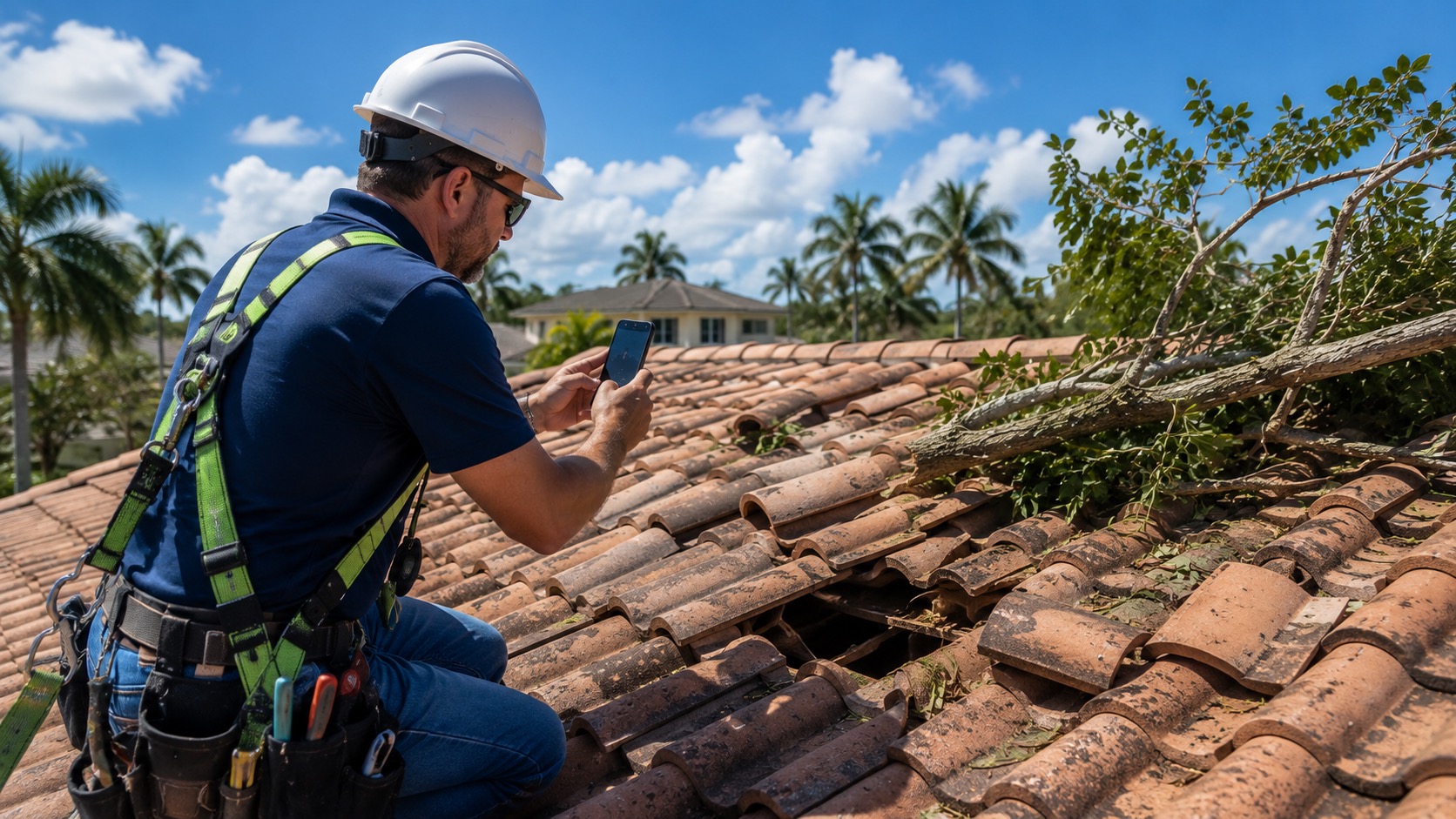
It depends on what caused the leak. Homeowners policies generally pay for damage from a covered event, such as wind, not for a roof that wore out. Citizens says it, “like other property insurers, doesn’t cover wear and tear or general maintenance,” and lists a worn roof as an example (Citizens). In practice, a leak that starts the night a storm tears off tiles or a branch punctures the roof is a candidate for a claim. A leak from underlayment that aged out over years usually is not.
Which deductible applies. A leak caused by a hurricane falls under the hurricane deductible, usually 2%, 5% or 10% of the dwelling limit, which you pay once per calendar year with the same insurer (§ 627.701, F.S.). It runs from the first hurricane warning for any part of Florida until 72 hours after the last watch or warning ends (Florida DFS). Damage from an afternoon thunderstorm falls under the all other perils deductible instead. With a 2% deductible on a $300,000 dwelling limit, you pay the first $6,000, so a minor repair from the table above may cost less than the deductible.
Document before you fix. Florida’s consumer guide says you must make reasonable emergency repairs to prevent further damage, photograph the damage and keep every receipt for materials and labor (Florida DFS toolkit). That duty to mitigate is why a tarp comes first. Hold off on permanent repairs until the insurer has had a chance to inspect.
Report on time. A new claim must be reported within 1 year of the date of loss (§ 627.70132, F.S.). The state’s hurricane deductible guide recommends filing even when damage seems smaller than the deductible, because the record counts toward the calendar-year deductible if another hurricane hits.
This is general information. Your policy’s exclusions and deductibles control, so read it or ask your agent. The full process is in our roof insurance claim guide.
What usually causes the leak in a Miami home
- Worn tile underlayment. It’s the usual source on aging tile roofs, and it often shows first at the eaves.
- Roof-to-wall and parapet flashing. Stucco cracks and failed counterflashing let wind-driven rain behind the roofing.
- Pipe and vent penetrations. Boots crack in UV, and lead flashings get damaged.
- Valleys. Debris and broken tile channel water under the roofing.
- Flat-roof seams and ponding. Water that sits for more than 48 hours finds every weak seam (ponding water).
If you want to look before calling anyone, here’s how to find a roof leak safely.
How to read a leak quote
- It names the entry point and shows a photo of it. “Seal roof” is not a scope.
- It says what gets rebuilt. That means flashing, underlayment or a membrane section, not “apply sealant.” A bead of caulk is a temporary fix.
- It prices extra decking up front per sheet or per square foot.
- It says who pulls the permit and whether one is needed.
- It includes a written workmanship warranty on the repair (warranties explained).
If the roof is old enough that repairs keep coming back, compare the numbers against a replacement first (repair or replace?).
Leaking right now? Tarp first
If water is coming in today, the first job is to stop it, not to price the permanent repair. Move belongings out of the way, catch the drip and, if the ceiling is bulging with water, keep people out of the room. Don’t climb onto a wet or damaged roof yourself.
A properly fastened tarp over the damaged area limits water entry until the repair can be scoped, permitted and done. It is temporary: wind can lift it and sun breaks it down, so it needs checking after every storm. It also protects an insurance claim, because insurers expect you to make reasonable emergency repairs to prevent further damage and keep the receipts (Florida DFS toolkit). Photograph the damage before the tarp goes on.
We offer same-day emergency tarping in Miami-Dade, Broward and Palm Beach. What a tarp can and can’t do is covered in our emergency roof tarping guide. Once the roof is covered, we scope the permanent fix through our roof repair service.
Have a leak now? We’ll find the entry point, photograph it and give you a written quote, line by line. Get a free quote or see our roof repair service.
Sources
- Fixr — How Much Does It Cost to Repair a Roof Leak? (updated January 27, 2026) (fixr.com)
- Fixr — How Much Does It Cost to Repair a Roof? (updated January 21, 2026) (fixr.com)
- Modernize — Roof Flashing Repair Cost (updated October 12, 2026) (modernize.com)
- Miami-Dade County Implementing Order 4-63 — Fee Schedule for RER Building and Neighborhood Compliance (effective October 1, 2026) (documents.miamidade.gov)
- Miami-Dade County RER — Homeowner's General Permit Information (miamidade.gov)
- Miami-Dade County RER — Roofing Permits (miamidade.gov)
- Florida Statutes 2026, § 553.79 — Permits; applications; issuance; inspections (flsenate.gov)
- Florida Statutes 2026, § 627.701 — Liability of insureds; coinsurance; deductibles (flsenate.gov)
- Florida Statutes 2026, § 627.70132 — Notice of property insurance claim (flsenate.gov)
- Florida Department of Financial Services — Florida's Hurricane Deductible (consumer guide) (myfloridacfo.com)
- Florida Department of Financial Services — Homeowners Insurance Toolkit (revised March 2024) (myfloridacfo.com)
- Citizens Property Insurance — Avoid These Common Insurance Myths (December 9, 2025) (citizensfla.com)