
Updated: October 20, 2026
An emergency roof tarp is a temporary cover over storm damage that limits how much water gets into the house until the roof can be properly repaired. It is not a repair: it’s held down against the wind, the sun breaks it down, and it has to be checked after every storm. Because installing one means working on a damaged, often wet roof, it’s a job for an equipped professional, not a homeowner.
When temporary protection helps
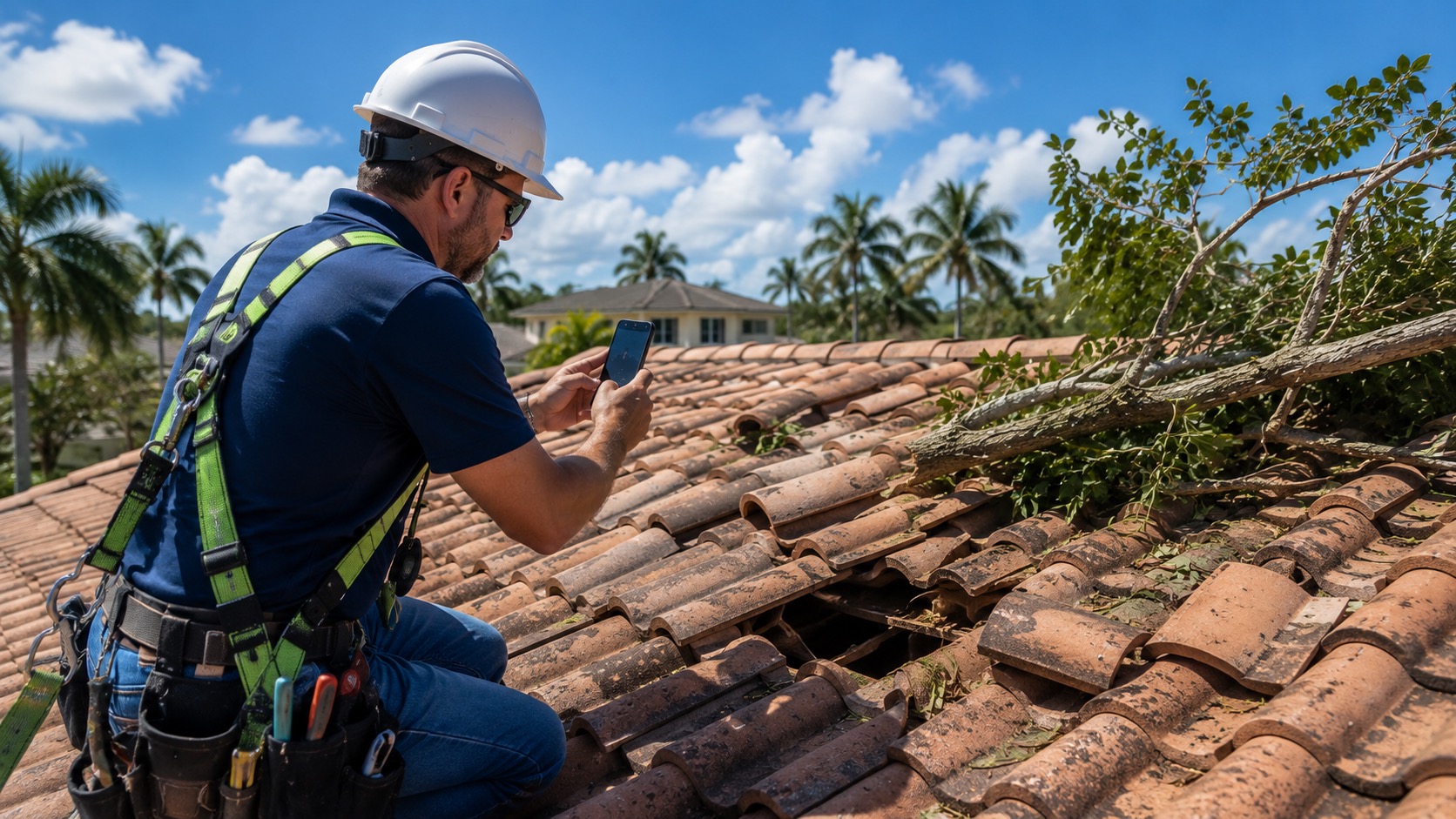
A temporary cover earns its place when there is an opening that will let rain in before a permanent repair can realistically happen. Typical cases:
- Missing tiles, shingles or panels that expose the underlayment or the deck.
- Punctures from a limb or flying debris.
- Damaged ridge or edge sections where wind has opened a gap.
- An active leak during a stretch of rainy weather, while the assessment, the insurer’s inspection, the materials or the permit are still pending.
It helps less, or not at all, when:
- The structure itself is damaged. If a tree has broken rafters or trusses, or the deck is sagging, the first question is whether anyone can safely be on that roof. OSHA’s guidance to professional crews is not to work on a damaged roof until its strength and structural integrity have been determined.
- The leak isn’t coming from an opening a tarp can cover. Failed flashing at a wall or a leaking pipe boot may need a targeted temporary seal instead.
- The weather is still bad. OSHA is explicit: never install a tarp during a storm while it is windy or raining.
The limits of a tarp
A tarp holds back water only as long as it stays in place and intact. Plan around its weaknesses rather than trusting it.
| Limit | What happens | What it means for you |
|---|---|---|
| Wind | Wind gets under loose edges and lifts or tears the sheet, the same way it peels roof coverings from the perimeter | A cover needs to be secured along its edges and checked after any strong wind |
| Duration | It’s built to bridge a gap, not to last. The U.S. Army Corps of Engineers’ Blue Roof sheeting, a heavier reinforced material than a typical retail tarp, has been described as designed to last approximately 30 days | Book the assessment and repair right away rather than waiting until the cover fails |
| Sun and heat | Plastic sheeting ages under sun and heat, and in South Florida that exposure is constant | Have it checked for brittleness and tears; replace it rather than patching it indefinitely |
| Re-securing | Every storm, and every visit by an adjuster or contractor, can loosen it | Ask whoever installed it to come back and check it; don’t climb up to do it yourself |
| Hidden damage | A cover hides what is beneath it from view | Make sure the damage was photographed before it was covered |
| Fastening | Anything fastened through the roof covering adds holes of its own | Ask how the cover is being secured, and photograph it in place |
The Corps’ own description of its program sums up the role: a cover that lets families stay in their homes “until they can make permanent repairs”.
Why you shouldn’t tarp the roof yourself
After a storm, a roof combines every hazard that makes roofing dangerous even for trained crews. Falls are the leading cause of death in construction. The OSHA fact sheet written specifically for roof tarping lists what crews face:
- Electrocution. Downed lines must be treated as live, generators can backfeed lines that look dead, and metal ladders must not be used near power lines.
- A weakened surface. Damaged decking, broken tiles and loose debris can give way underfoot.
- A slippery surface. “Do not walk on a tarp. A tarped roof will be very slippery, especially when wet.”
- Hidden openings. Skylights and holes covered by a tarp are not visible to someone walking on it.
- Fall protection. On steeper roofs, OSHA calls for conventional fall protection systems, not just care and balance.
Ready.gov’s post-hurricane guidance adds the ground-level hazards: don’t touch wet electrical equipment or stand in water that downed lines could have charged.
So the homeowner’s job is the safe part: keep people out of rooms with sagging ceilings, move belongings away from leaks, put buckets under drips and call a roofer.
Documenting the damage safely, before and after the cover goes on
Once a tarp is on, the damage under it can’t be seen. Record it first.
- Before: photos and video from the ground, from windows and from inside (ceilings, walls, floors, contents). Photograph debris in the yard before cleanup.
- During: ask the roofer to photograph the damaged area up close before covering it, with enough context to show where it is on the roof.
- After: photos of the installed cover from the ground, plus the roofer’s photos from the roof.
- Paperwork: an invoice that says what was covered, where, with what, and on what date. Keep it with your claim file.
The Florida Department of Financial Services’ current storm guidance puts it simply: “make emergency repairs to prevent further damage and document them”. The same guidance says to verify the license of any contractor and not to rush into signing contracts. Our after-the-storm documentation guide has a full damage log you can copy.
What to expect after the tarp: assessment and repair
The cover buys time to find out what actually failed. A typical sequence:
- Assessment. A roofer inspects the damaged area and the rest of the roof, from the roof with fall protection and from the attic. On a tile roof that usually means looking under tiles near the damage, because the underlayment below may be compromised even where the tiles look fine.
- Written scope. What failed, what needs replacing, and whether a section repair is enough or the damage points toward a larger job.
- Insurance. If you’re filing a claim, the adjuster may want to see the roof, and the roofer’s photos and scope become part of your file. See our roof insurance claim guide.
- Permit and materials. Permanent repairs are permitted work (see below), and the replacement materials have to suit the roof’s approved system. Ask which product approval covers them, for example a Miami-Dade NOA or a Florida Product Approval number.
- Repair and removal of the temporary cover, followed by any inspection the permit requires.
Temporary mitigation vs permanent repair
| Temporary mitigation | Permanent repair | |
|---|---|---|
| Purpose | Limit further damage now | Restore the roof system |
| Examples | Tarp or temporary membrane over an opening, temporary seal at a leak, interior water extraction | Replacing the damaged underlayment, covering, flashing or decking to the approved system |
| Lifespan | Short and uncertain | Designed to perform as part of the roof |
| Who does it | A professional for anything on the roof; homeowner only for safe interior steps | A licensed roofing contractor |
| Permit | Ask your building department or your roofer how your jurisdiction treats emergency measures | Generally required |
| Records to keep | Photos before and after, invoice, dates | Permit, scope, invoice, inspection results, product approvals |
Permits apply to permanent repairs
Florida law makes it unlawful to construct, alter, modify, repair or demolish a building without first obtaining a permit from the local enforcing agency, unless the law provides otherwise. The Florida Building Code and your local building department decide which small repairs, if any, fall outside that requirement, and whether your address is handled by the county or by a city building department. Don’t assume a repair is too small to need a permit; a licensed roofer pulls the permit as part of the job. Our guide to roof permits in Miami-Dade, Broward and Palm Beach walks through the process.
Timing matters this year: Miami-Dade’s permitting center notes that the Florida Building Code 9th Edition (2026) takes effect on December 31, 2026, and applications submitted on or after that date must comply with it.
Use the repair to make the roof stronger
A repair is also a chance to fix the weak points storms exploit. IBHS’s FORTIFIED program notes that roof damage often begins when wind gets under the roof edge, and that sealing the roof deck’s seams can sharply reduce water intrusion if the covering is lost. Ask whether the edge metal, the deck attachment and the secondary water protection in the repaired area can be brought up to the current approved system.
After a federal disaster declaration
After some major disasters, the U.S. Army Corps of Engineers runs Operation Blue Roof, which installs reinforced temporary sheeting at no charge to eligible homeowners who sign a right-of-entry form. It isn’t available after every storm, so check local emergency management announcements for whether it has been activated and who qualifies. It is still temporary, and the permanent repair is still yours to arrange.
Next step
If storm damage has opened your roof, get it assessed so the temporary cover is only temporary. Art’s Roofing & Construction (Florida licenses CCC1333598 and CGC1541858) repairs tile, shingle, metal and flat roofs across Miami-Dade, Broward and Palm Beach. See our roof repair service or request a free estimate.
Sources
- Roof Tarping (Blue Roof) Safety — OSHA Fact Sheet DOC FS-3926 (osha.gov)
- OSHA's Fall Prevention Campaign (osha.gov)
- Corps installs last Blue Roof in Puerto Rico — U.S. Army (Mar. 22, 2018) (army.mil)
- USACE's Operation Blue Roof contractors install final Blue Roof in Florida — U.S. Army (Nov. 21, 2024) (army.mil)
- Hurricanes | Ready.gov (ready.gov)
- CFO and State Fire Marshal Blaise Ingoglia visits Palm Beach County on eighth stop in statewide hurricane preparedness tour (Aug. 25, 2026) (myfloridacfo.com)
- Florida Statutes § 553.79 — Permits; applications; issuance; inspections (2026) (flsenate.gov)
- Florida Building Code 9th Edition Code Change — Miami-Dade Permitting and Inspection Center notice (miamidade.gov)
- FORTIFIED Roof — IBHS (fortifiedhome.org)