Updated: November 15, 2026
After a Florida storm, whether a roof claim gets paid usually comes down to three things: proof of what the storm did, reporting it on time and knowing which deductible applies. This guide covers each step, with the Florida statutes and state consumer guides behind it.
This is general information, not legal advice. Policies differ. Read your own policy, and call your agent or the state’s toll-free Insurance Consumer Helpline at 1-877-693-5236 (Florida DFS) with questions about your coverage.
What should you do in the first 48 hours after roof damage?
- Stay off the roof. Document from the ground, from a window and from inside the house.
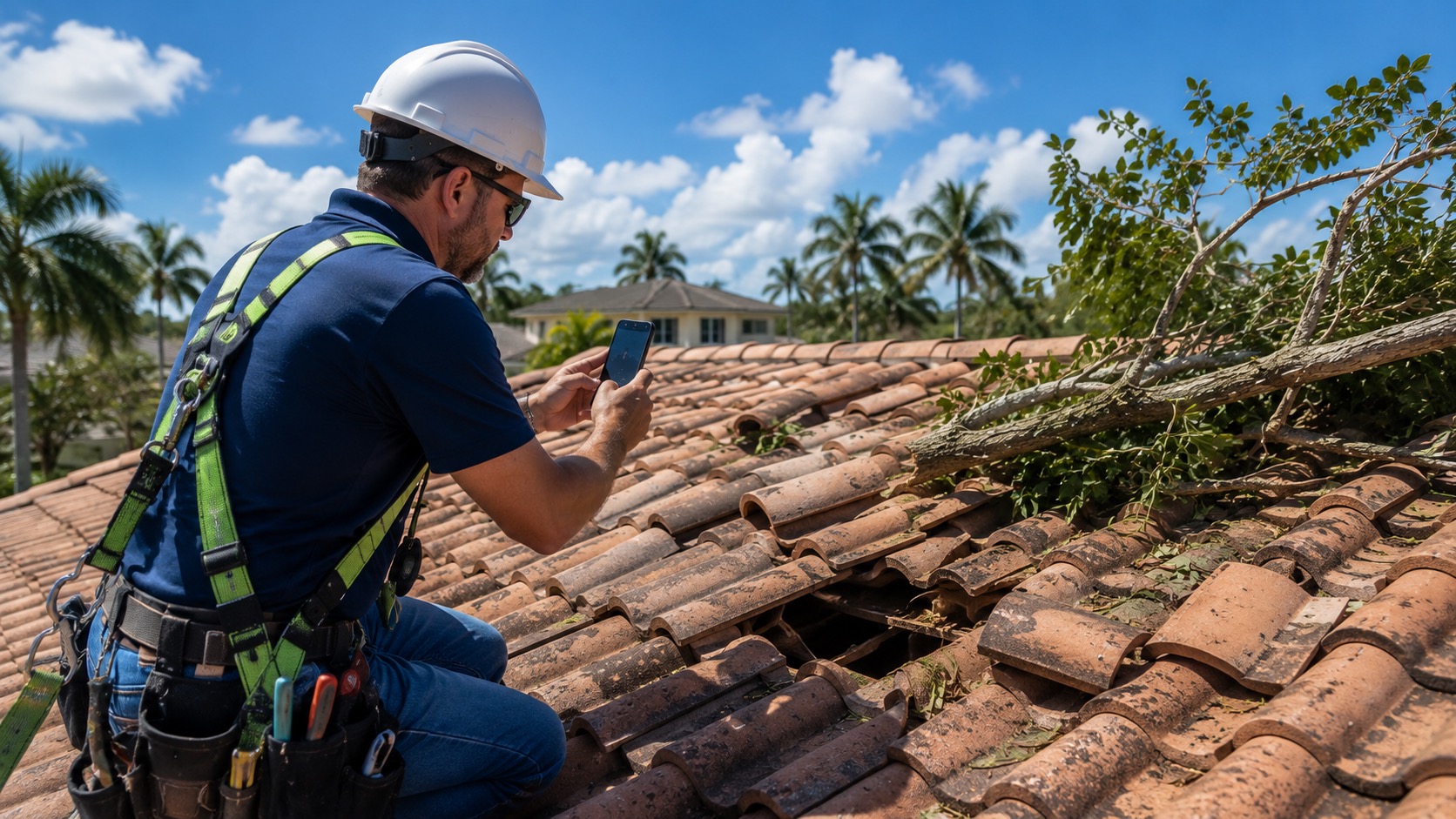
- Photograph and video everything. Take wide and close shots of the roof, debris in the yard, ceiling stains and wet insulation. Date-stamped files are best.
- Stop further damage. Florida’s consumer guide says that whether a home is damaged by a hurricane or any other cause, you must make reasonable emergency repairs to prevent further damage, photograph the damage and save all receipts for materials and labor (Florida DFS toolkit). On a roof, that usually means a tarp. See emergency roof tarping.
- Hold off on permanent repairs. The insurer has a right to inspect the damage before paying, and the guide says not to throw away damaged property until the adjuster says so.
- Keep a log. Write down dates, times and names of everyone you speak with, and keep a copy of anything you sign.
How long do you have to file a roof claim in Florida?
| Claim type | Deadline to notify the insurer |
|---|---|
| New or reopened claim | Within 1 year after the date of loss |
| Supplemental claim (more damage or cost found later) | Within 18 months after the date of loss |
Source: § 627.70132, F.S..
For a hurricane, the date of loss is the date the hurricane made landfall. For other windstorms, it is the date the event is verified by the National Oceanic and Atmospheric Administration (§ 627.70132, F.S.). Florida has tightened these deadlines in recent years. Don’t wait for them: file once you have photos and a written inspection.
What must the insurer do after you file?
Florida law puts deadlines on the insurer too:
| Insurer’s duty | Deadline |
|---|---|
| Review and acknowledge your claim communication | 7 calendar days |
| Begin investigating | 7 days after receiving proof-of-loss statements |
| Physically inspect the property, if needed | 30 days after receiving proof-of-loss statements |
| Send you a copy of any detailed estimate of the loss | 7 days after the estimate is generated |
| Pay or deny the claim (or part of it) | 60 days after receiving notice of the claim |
Source: § 627.70131, F.S..
Ask for the adjuster’s estimate in writing and compare it with your roofer’s. Gaps usually show up in square footage, underlayment, flashing and code-required items.
Which deductible applies to your roof claim?
Florida homeowners policies can carry more than one deductible, and which one applies depends on the cause and timing of the damage:
- Hurricane deductible. Insurers must offer hurricane deductibles of $500, 2%, 5% and 10% of the dwelling limit (§ 627.701(3), F.S.). It applies from the moment the National Hurricane Center issues a hurricane warning for any part of Florida until 72 hours after the last hurricane watch or warning ends (Florida DFS). You pay it once per calendar year if you stay with the same insurer or insurer group (§ 627.701(5), F.S.).
- All other perils deductible. This one covers everything else, such as an afternoon thunderstorm or a fallen tree outside a hurricane window. Insurers must offer a $500 option for non-hurricane losses (§ 627.701(7), F.S.).
- Roof deductible. Some policies carry a separate roof deductible, capped at the lesser of 2% of the Coverage A limit or 50% of the cost to replace the roof (§ 627.701(10), F.S.). It does not apply when the hurricane deductible applies (Florida DFS).
Example: with a $300,000 dwelling limit and a 2% hurricane deductible, you pay the first $6,000 of a hurricane loss. The state’s guide recommends filing even when damage looks smaller than the deductible, because the claim creates a record that counts toward the calendar-year deductible if a second hurricane hits (Florida DFS).
How does the insurer pay for a roof?
On a replacement cost policy, the insurer must first pay at least the actual cash value of the loss, minus the deductible, and then pay the rest as the work is done and expenses are incurred. If a separate roof deductible applies, the insurer may limit the roof payment to actual cash value until you show reasonable proof you paid that deductible, such as a canceled check or a financing contract (§ 627.7011(3), F.S.).
Actual cash value subtracts depreciation for age and condition. The state’s guide uses the example of a 17-year-old roof with a 20-year life expectancy (Florida DFS toolkit). Roof age can also affect renewal. See the 15-year roof rule and Citizens roof requirements.
Why do roof claims get denied?
- Wear and tear. Citizens says it, “like other property insurers, doesn’t cover wear and tear or general maintenance,” and names a worn roof as an example (Citizens). An old leak with no storm opening is hard to claim.
- Late notice. Past the 1-year deadline, even real storm damage may not be recoverable.
- Pre-existing damage. Old, undocumented problems get blamed for new ones. Photos from a routine inspection help here.
- No proof of cause. A roofer’s written report with photos ties the damage to the storm date.
- Flood. Rising water from outside is not covered by most property policies (Citizens).
What can a roofer legally do on your claim?
A licensed roofer can inspect, photograph, explain the damage and give you a good-faith itemized estimate. Florida law bars contractors from interpreting your policy or adjusting your claim unless they are licensed public adjusters. It also bars them from offering rebates, gifts, cash or a deductible waiver for an inspection or a claim (§ 489.147(2), F.S.). Roofing contracts must include notices about these rules. For contracts signed within 180 days of a declared state of emergency, the homeowner can cancel within 10 days of signing or by the official start date, whichever comes first (§ 489.147(6), F.S.).
Assignment of benefits. For residential policies issued on or after January 1, 2023, an attempt to assign post-loss benefits is “void, invalid, and unenforceable” (§ 627.7152(13), F.S.). A contractor shouldn’t ask you to sign one. Keep control of your own claim.
What if you disagree with the insurer’s decision?
Florida runs a property insurance mediation program for residential claims. Policyholders can request it before appraisal or a lawsuit, the insurer pays the cost of the mediation conference, and insurers must notify you of this right (§ 627.7015, F.S.). Some disputes are excluded, such as amounts under $500 unless both sides agree. The DFS helpline can explain how to request it.
Next step
If a storm hit your roof, get it documented before anything is repaired. We inspect, photograph each damaged area and give you a written report and itemized estimate you can share with your insurer. Request a free inspection or see our roof repair service.
Sources
- Florida Statutes 2026, § 627.70132 — Notice of property insurance claim (flsenate.gov)
- Florida Statutes 2026, § 627.70131 — Insurer's duty to acknowledge communications regarding claims; investigation (flsenate.gov)
- Florida Statutes 2026, § 627.701 — Liability of insureds; coinsurance; deductibles (flsenate.gov)
- Florida Statutes 2026, § 627.7011 — Homeowners' policies; replacement cost coverage (flsenate.gov)
- Florida Statutes 2026, § 627.7152 — Assignment agreements (flsenate.gov)
- Florida Statutes 2026, § 489.147 — Prohibited property insurance practices (flsenate.gov)
- Florida Statutes 2026, § 627.7015 — Alternative procedure for resolution of disputed property insurance claims (mediation) (flsenate.gov)
- Florida Department of Financial Services — Florida's Hurricane Deductible (consumer guide) (myfloridacfo.com)
- Florida Department of Financial Services — Homeowners Insurance Toolkit (revised March 2024) (myfloridacfo.com)
- Citizens Property Insurance — Avoid These Common Insurance Myths (December 9, 2025) (citizensfla.com)