Updated: October 20, 2026
An afternoon thunderstorm damages a roof in a short, local burst: a few minutes of downburst wind, a heavy downpour, sometimes hail. A hurricane works on the same roof for hours, over a whole region, with flying debris and rain driven sideways. Florida insurance treats them differently too: the hurricane deductible applies only to hurricane losses inside a time window defined by statute, and other storm damage falls under your regular deductible.
How afternoon thunderstorms damage roofs
The National Weather Service classifies a thunderstorm as severe when it produces a tornado, winds of at least 58 mph, or hail at least 1 inch in diameter. NWS Miami describes severe thunderstorms as fairly common in South Florida, possible year-round and most common from March to August, and notes that winds above 58 mph can damage trees, knock down power lines and cause structural damage to buildings.
The wind that does the damage is usually a downburst: a strong downdraft from a thunderstorm cloud that can produce damaging winds at the surface. The smallest and sharpest version, a microburst, affects an area less than 2½ miles wide, with peak winds lasting less than 5 minutes. These are straight-line winds, meaning wind not associated with rotation, as opposed to a tornado.
What that tends to look like on a roof:
- Localized damage. One street, one side of a house, one slope. The neighbor’s roof may be untouched.
- Damage on the side facing the burst. Lifted shingles, displaced tiles or bent edge metal concentrated where the outflow hit.
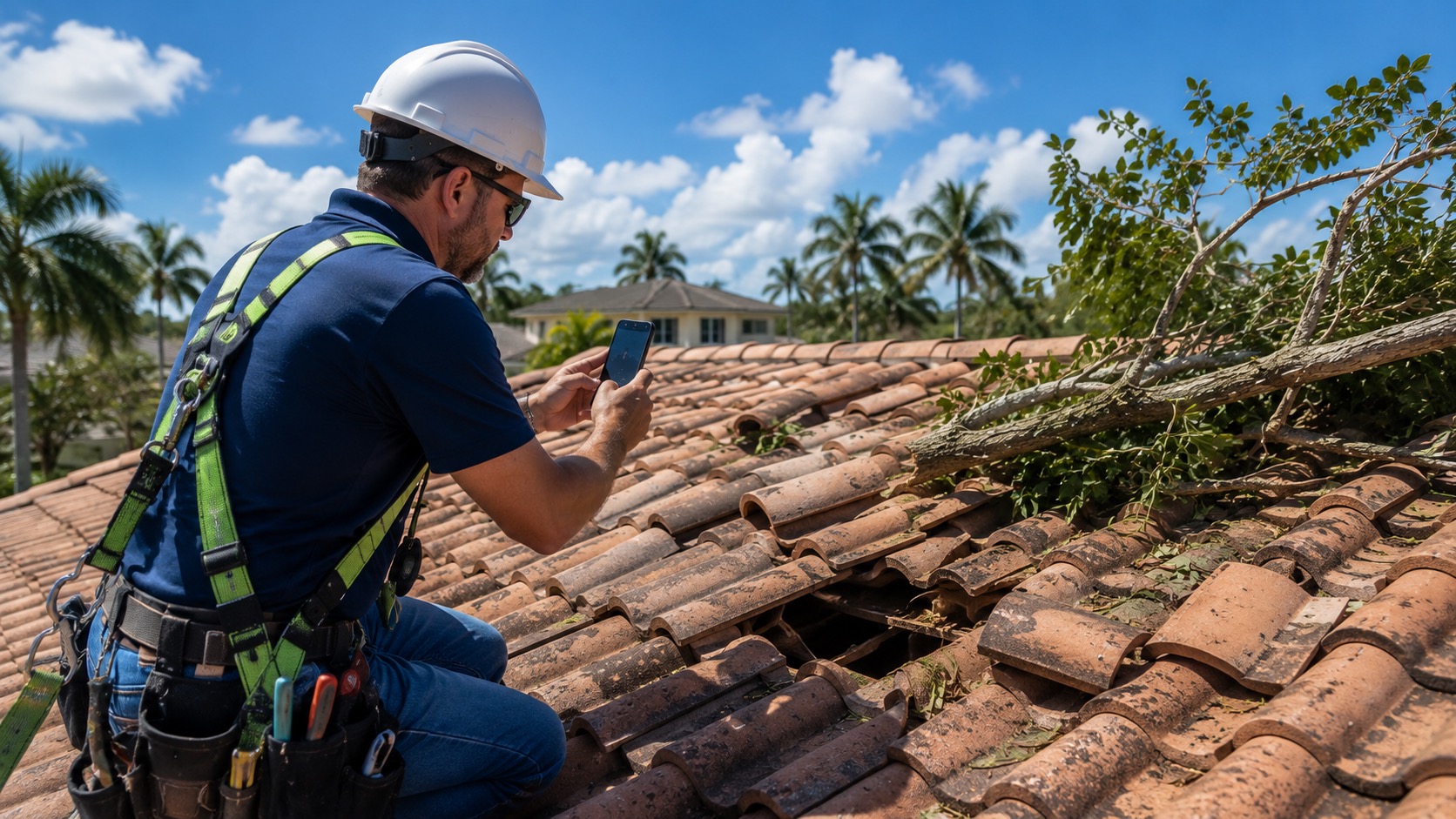
- Tree damage. Broken limbs falling on or scraping across the roof.
- Rain finding existing weak points. A short, very heavy downpour exposes tired flashing, pipe boots and underlayment.
- Occasionally hail or a brief tornado. NWS Miami notes that South Florida tornadoes can form from ordinary afternoon thunderstorms when conditions are right; more than 90% of them are EF-0 or EF-1, typically causing broken branches, downed lines and minor roof damage.
How hurricanes damage roofs
A hurricane is a tropical cyclone with maximum sustained winds of 74 mph or more. The difference for a roof is less about one peak gust and more about duration, area and what the wind carries:
- Hours of loading. Wind keeps working on every edge and every loose piece, long after a downburst would have passed.
- Edge-first failure. IBHS notes that roof damage often begins when wind gets underneath the roof edge and starts ripping it away. Once an edge goes, the covering can peel back from there. Our guide to hurricane roofing explains this mechanism layer by layer.
- Flying debris. The National Hurricane Center warns that signs, roofing material, siding and small items left outside become flying missiles. A tile from one roof can break another.
- Wind-driven rain. Once the covering or an opening is breached, rain gets in over a long period.
- Tornadoes in the rain bands, most often in thunderstorms embedded in bands well away from the center.
- Flooding, which is a separate peril. Florida’s emergency management agency warns that most insurance policies do not cover flooding.
Side by side
| Afternoon thunderstorm / downburst | Hurricane | |
|---|---|---|
| Duration of damaging wind | Minutes | Hours |
| Area affected | Very local; can vary street to street | Regional |
| Typical roof damage | Localized lifting, limb impact, leaks at weak points | Edge and ridge failures, widespread covering loss, debris impact, prolonged water intrusion |
| Other hazards | Lightning, hail, brief tornadoes | Flooding, tornadoes in rain bands |
| Deductible usually applied | Regular (all-other-perils) | Hurricane deductible, if inside the statutory window |
These are tendencies, not rules. A strong downburst can do serious damage, and a weak hurricane may only cost a few tiles. The roof’s condition before the storm matters as much as the storm itself.
Why insurers treat them differently
This section explains how the deductibles work under Florida law. It is not legal advice; your policy and your insurer decide how a specific claim is handled.
Two deductibles on one policy
A Florida residential policy can carry a hurricane deductible and a separate deductible for perils other than hurricane, often called the all-other-perils (AOP) deductible. For personal lines policies, § 627.701 requires insurers to offer hurricane deductible options of $500, 2%, 5% and 10% of the dwelling limit (unless the percentage works out to less than $500), and a $500 option for losses from perils other than hurricane. Your declarations page shows which ones you have; for personal lines policies the law requires the dollar value of the hurricane deductible to be shown there. The same statute also refers to policies with a separate roof deductible, so check whether yours has one.
When the hurricane deductible applies
Under § 627.4025, Florida Statutes (2026), hurricane coverage means loss caused by windstorm during a hurricane, and “hurricane” means a storm the National Hurricane Center has declared a hurricane. The hurricane’s duration, for insurance purposes:
- Begins when the National Hurricane Center issues a hurricane warning for any part of Florida.
- Ends 72 hours after the last hurricane watch or hurricane warning for any part of Florida is terminated.
What follows from that definition:
- An ordinary afternoon thunderstorm, with no hurricane involved, is not a hurricane loss. It’s handled under the regular deductible.
- A tropical storm that never becomes a hurricane doesn’t meet the statutory definition of a hurricane.
- The window is statewide. A warning for any part of Florida starts it, even if your county was never under a warning.
- A separate thunderstorm during the window is a judgment call about cause and policy wording. If damage happened during an active hurricane window, ask your insurer which deductible they’re applying and why.
The calendar-year rule
For personal lines policies, the hurricane deductible applies on an annual basis to all covered hurricane losses in a calendar year with the same insurer or insurer group. For a second hurricane in the same year, the insurer applies the greater of the remaining hurricane deductible or the AOP deductible. That’s why the Department of Financial Services advises filing hurricane claims even when the damage is below the deductible: it creates a record of what counts toward it.
Same deadlines either way
Florida’s claim-notice deadlines don’t depend on the type of storm: 1 year from the date of loss for a new or reopened claim and 18 months for a supplemental claim. For weather events, the date of loss is the hurricane’s landfall date, or the date the windstorm, severe rain or other weather event is verified by NOAA.
What to document after either kind of storm
The record that helps is the same, with a few additions that matter for telling the storms apart:
- Date and time you noticed the damage, and when the storm hit. For a thunderstorm, note it the same day; there won’t be a named storm to point to.
- The pattern. Photograph every side of the house from the ground. Localized damage on one side, or damage on several sides and slopes, tells part of the story.
- Debris and its source. A neighbor’s tile in your yard, a limb from a specific tree, a sheet of metal from somewhere else.
- Interior evidence with dates: new stains, drips, wet insulation if the attic is safely accessible.
- Pre-storm condition, if you have it: earlier photos, inspection reports or repair invoices help separate storm damage from wear.
- Your declarations page, so you know which deductibles you are dealing with.
Stay off the roof. Our after-the-storm guide covers safety and has a damage log to copy, and the roof insurance claim guide covers working with the adjuster. If the storm brought hail, see hail damage on South Florida roofs.
Next step
Whatever kind of storm it was, a roofer’s assessment and photos are the evidence that ties the damage to the event. Art’s Roofing & Construction (Florida licenses CCC1333598 and CGC1541858) inspects and repairs storm-damaged roofs across Miami-Dade, Broward and Palm Beach. See our roof repair service or request a free estimate.
Sources
- NWS Glossary — Severe thunderstorm (forecast.weather.gov)
- NWS Glossary — Downburst (forecast.weather.gov)
- NWS Glossary — Microburst (forecast.weather.gov)
- NWS Glossary — Straight-line winds (forecast.weather.gov)
- 2025 Severe Weather Awareness Week — Tornado and Thunderstorm Awareness Day (NWS Miami–South Florida) (weather.gov)
- Hurricane Preparedness — Hazards (NOAA National Hurricane Center) (nhc.noaa.gov)
- NHC Glossary — Hurricane, Hurricane Watch, Hurricane Warning (nhc.noaa.gov)
- Florida Statutes § 627.4025 — Residential coverage and hurricane coverage defined (2026) (flsenate.gov)
- Florida Statutes § 627.701 — Liability of insureds; coinsurance; deductibles (2026) (flsenate.gov)
- Florida Statutes § 627.70132 — Notice of property insurance claim (2026) (flsenate.gov)
- Florida's Hurricane Deductible — Florida Department of Financial Services (myfloridacfo.com)
- Flood Insurance — Florida Division of Emergency Management (floridadisaster.org)
- FORTIFIED Roof — IBHS (fortifiedhome.org)