
Updated: October 20, 2026
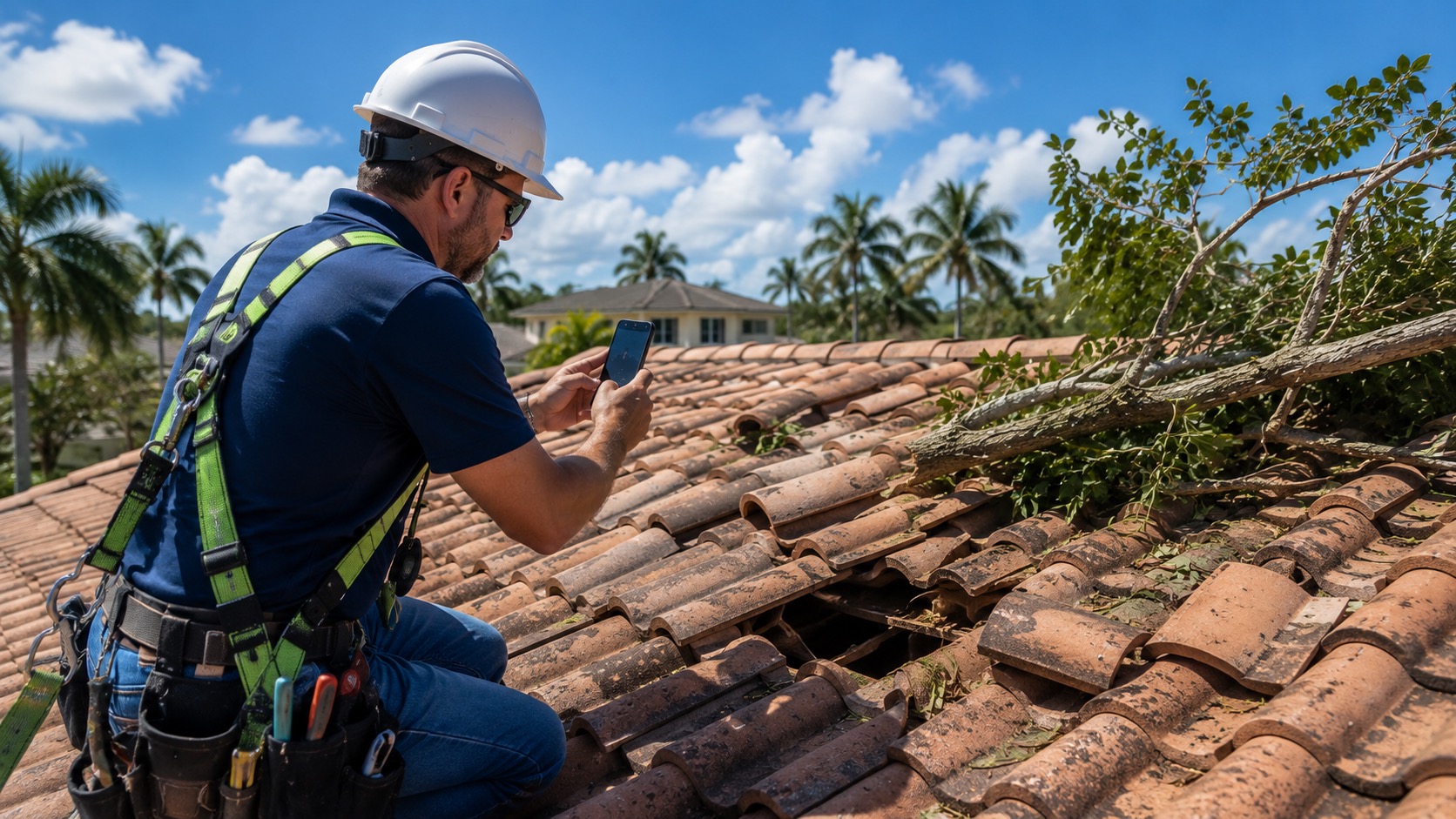
Your roof permit is issued by the building department of the city your property sits in, or by the county if the address is unincorporated. In most cases your licensed roofer files the application in its own name, the inspector checks the roof while the underlayment and fastening are still visible and again at the end, and you, the owner, are responsible for the Notice of Commencement.
This guide covers the process. For what the code requires of the roof itself (the High-Velocity Hurricane Zone, product approvals, who may do the work), see our Miami-Dade roofing guide.
Who issues my roof permit?
It depends on the address, not on the county name in your mailing address. Each of the three counties works the same way: cities with their own building department permit their own territory, and the county permits the unincorporated area.
| County | Unincorporated addresses | Inside a city | How to tell which you are |
|---|---|---|---|
| Miami-Dade | Miami-Dade County Regulatory and Economic Resources (RER) | The city’s own Building Official | Folio number starting with “30” = unincorporated (Miami-Dade RER) |
| Broward | Broward County Building Code Division (unincorporated areas and cities that contract with it) | The city’s building department | Check your property record, then ask the department |
| Palm Beach | Palm Beach County PZB Building Division | The municipality | Parcel control number starting with “00” = unincorporated (PBC FAQ) |
Miami-Dade states it plainly: “Each municipality in Miami-Dade County has its own Building Official who issues building permits for work within that city’s limits” (How to Apply for a Permit). The City of Miami tells applicants that a folio beginning with “01” is inside city limits (Get a Roofing Permit). In Broward, the Building Code Division regulates construction in unincorporated Broward and the cities it contracts with, and the Board of Rules and Appeals handles the county’s code amendments, appeals and formal interpretations. In Palm Beach, the county Permit Center processes applications “in the unincorporated area of Palm Beach County.”
Some cities add their own reviews on top of the building permit. Coral Gables, for example, lists City Architect / Board of Architects approval and historic review “where applicable” for roofs (Coral Gables permit requirements).
What goes into a roof permit application?
The exact list belongs to each department, but in Miami-Dade and Broward (the High-Velocity Hurricane Zone, or HVHZ) the core is the same:
- The uniform roofing permit application. Miami-Dade says it “is required for all roofing permits,” with Sections A and B (general information, roof type, roof plan) plus the Section C, D or E forms for the specific system: built-up, single-ply, shingle, tile, metal, tile calculations (Miami-Dade Roofing Permits).
- Product approvals for the roof system: a Miami-Dade Notice of Acceptance (NOA) or a Florida Product Approval.
- The Owner’s Notification for Roofing Considerations (Florida Building Code Section 1524), which explains common re-roof conditions. Miami-Dade notes it is “the responsibility of the roofing contractor to inform the property owner.”
- Hurricane mitigation forms for single-family re-roofs: affidavits covering roof-deck attachment, the secondary water barrier, and roof-to-wall connections (or the owner’s affidavit of exemption).
Two cities’ published checklists show how the details vary:
| City of Miami (residential tile re-roof) | City of Coral Gables (new roof or re-roof) |
|---|---|
| Roofing permit application | Site plan, roof plan and exterior elevations (a survey cannot serve as the site plan) |
| HVHZ form, Sections A, B and D, with roof plan, dimensions and slope | HVHZ roof permit application, Sections A–E, latest edition |
| Miami-Dade NOA or Florida Product Approval for the system | NOA or Florida Product Approval for each roof component |
| UL listing for the system | Color photos of the existing roof, the work area and the front of the house |
| Owner’s notification (Form 1524) | Tile or material specification and color |
| Owner’s Affidavit of Exemption | Owner’s Affidavit of Exemption and Owner’s Notification |
Sources: City of Miami tile re-roof checklist and Coral Gables permit requirements, rev. 07.22.2026. Both say their lists are not exhaustive.
Small repairs
A provision in the 2026 Florida Statutes lets the owner of a single-family home, or the owner’s contractor, ask the local government for a permit exemption for work valued under $7,500. It excludes electrical, plumbing, structural, mechanical and gas work and properties in a flood hazard area, and it needs a written request with the contract or other proof of value (§ 553.79(1)(g), F.S.). The statute does not mention roofing by name, so whether a roof repair qualifies is the building department’s call. Ask before any work starts.
Which inspections does a re-roof get?
Inspectors look at the roof while the parts that matter are still visible: the deck and its fastening, the underlayment and its fasteners (the “tin cap” or dry-in stage), the covering as it goes on, then the finished roof. Here is how three departments list them:
| Miami-Dade County (unincorporated): roofing inspection codes | City of Miami: residential tile re-roof checklist | Palm Beach County: amended FBC Section 110.3 |
|---|---|---|
| 059 Tin Cap / Dry In / Base Sheet / Anchor Sheet | Insulation | At least two inspections covering dry-in, insulation, roof coverings (“including In Progress as necessary”), roof-deck insulation, flashing and sheathing |
| 063 Cap Sheet / Hot Mop / In Progress | In Progress Tile/Shingle/Metal | Re-roof sheathing: a notarized affidavit from a licensed roofing contractor may be accepted, at the building official’s discretion |
| 010 Tile Placing; 009 Time of Installation | Tin Cap | |
| 001 Final | Final Building Roofing |
Sources: Miami-Dade inspection codes, City of Miami checklist, Palm Beach County amendments to the FBC 8th Edition.
Coral Gables lists, “where applicable,” lightweight concrete installation, mopping, uplift test, tile or shingle placing, tin caps, and final building, public works and historic inspections. Which ones apply depends on the system. A flat roof and a tile roof do not get the same sequence. To see where these inspections fall in a real job, read a re-roof day by day.
What does the contractor handle, and what does the owner handle?
The licensed contractor
- Applies for and holds the permit. Miami-Dade: “Building permits are issued in the name of the person(s) performing the work; only licensed contractors, or Owner-Builders may obtain a permit.” The county adds that a permit “makes the contractor legally responsible for their portion of the work” (Owner-Builder Permits).
- Prepares the HVHZ forms and product approvals and explains the owner’s notification to you.
- Requests and passes the inspections. The City of Miami requires the printed permit card to stay on site “at all times.”
- May use a private provider. Florida law lets the owner, or the contractor with the owner’s written authorization, hire a licensed private provider for plan review, inspections or both. The local building official must get written notice on the Commission’s form (§ 553.791, F.S.).
The owner
- Signs the application when a contractor is hired (Miami-Dade notes you sign the building permit application describing the work).
- Records the Notice of Commencement. Under § 713.13, the owner (or the owner’s authorized agent) records it before work starts and posts a certified copy or a notarized statement on the job site. The statutory form warns that it “MUST BE RECORDED AND POSTED ON THE SITE OF THE IMPROVEMENT BEFORE THE FIRST INSPECTION.” The building department must require proof of it before the first inspection when the direct contract is over $5,000 (§ 713.135(1)(e)). A notice expires one year after recording unless it states otherwise, and is void if work does not start within 90 days.
- Asks to see the permit. Miami-Dade’s advice to owners: “If you hire a contractor, always ask to see the permit for your project. If no permit is obtained, you (the owner) are legally responsible.”
The owner-builder option, and why it is rarely right for a roof
Florida lets property owners act as their own contractor on a one- or two-family home for their own use, as long as they personally supervise all work not done by licensed contractors, appear in person to sign the application and sign a disclosure statement. Selling or leasing within one year of completion creates a presumption that the work was done for sale or lease (§ 489.103(7), F.S.). Local rules can be narrower. The City of Miami says the owner-builder option for roofs “is available to shingle roofs only” and requires an exam and an interview.
The practical warning comes from Miami-Dade itself: “If a contractor tells you to get an owner-builder permit, you become legally responsible for all the work done.” The owner also takes on insurance for anyone on the job who is not a licensed contractor. Before you hire, check a roofer’s license and permit habits; our contractor checklist explains how.
How long does a roof permit take?
No single number applies, and we will not invent one. Here is what is actually published:
- State law sets maximum review times once an application is complete and sufficient and the applicant uses the local government’s plans reviewer: 5 business days for a roofing permit on an existing single-family home when the work is valued under $15,000, and 30 business days for a roofing permit on a structure under 7,500 square feet. The department must flag an incomplete application within 5 business days (§ 553.792(1), F.S., 2026 statutes).
- The City of Miami says the first review cycle for a building permit “can take up to 14 business days,” and corrections “may need to be repeated several times” (page checked October 20, 2026).
- Miami-Dade’s e-permitting system lets qualified contractors obtain certain residential roofing permits online for unincorporated addresses (Roofing Permits).
What actually moves the timeline:
- Completeness. The review clock in § 553.792 starts with a “complete and sufficient” application. Missing approvals, the wrong form version or wrong file names (a common rejection in the City of Miami portal) restart the loop.
- Product approvals that match the roof. The approval has to cover your deck, slope and system as drawn.
- Extra local reviews such as an architectural board or historic review.
- The Notice of Commencement, recorded before the first inspection.
- Inspection scheduling and re-inspections. Each stage must pass before work continues.
- Weather. Inspections at the dry-in stage need a roof that can be inspected.
- The code edition changeover. The Florida Building Code 9th Edition (2026) is scheduled to take effect December 31, 2026, and Miami-Dade says applications submitted on or after that date must comply with it. See which Florida Building Code edition applies to your roof.
Once issued, a single-family building permit expires one year after issuance or on the effective date of the next Florida Building Code edition, whichever is later, and the local government may extend it (§ 553.79(1)(c)). At the end, ask for proof that the final inspection passed and the permit is closed, and keep it with your warranty papers.
Next step
If you are planning a re-roof, a roofer should tell you, before you sign, which department will issue your permit, which product approvals will be submitted and which inspections to expect. Art’s Roofing & Construction holds Florida licenses CCC1333598 and CGC1541858 and works across Miami-Dade, Broward and Palm Beach. See how we handle a roof replacement, or request a free estimate.
Sources
- Miami-Dade County RER — How to Apply for a Permit (miamidade.gov)
- Miami-Dade County RER — Homeowner's General Permit Information (miamidade.gov)
- Miami-Dade County RER — Roofing Permits (miamidade.gov)
- Miami-Dade County RER — Inspection Type Codes (miamidade.gov)
- Miami-Dade County RER — Owner-Builder Permits (miamidade.gov)
- City of Miami — Get a Roofing Permit (miami.gov)
- City of Miami — Residential Permit: Re-Roofing – Tile Roof: Applicant Checklist (miami.gov)
- City of Coral Gables Development Services — Permit Requirements (rev. 07.22.2026) (coralgables.com)
- Broward County — Building Code Division (broward.org)
- Broward County — Board of Rules and Appeals (broward.org)
- Palm Beach County PZB — Building Division Permit Center (discover.pbc.gov)
- Palm Beach County PZB — Building FAQ (discover.pbc.gov)
- Palm Beach County Amendments to the Florida Building Code, 8th Edition (2023) (discover.pbc.gov)
- Florida Statutes (2026) § 489.103 — Exemptions (owner-builder) (flsenate.gov)
- Florida Statutes (2026) § 713.13 — Notice of commencement (flsenate.gov)
- Florida Statutes (2026) § 713.135 — Notice of commencement and applicability of lien (flsenate.gov)
- Florida Statutes (2026) § 553.79 — Permits; applications; issuance; inspections (flsenate.gov)
- Florida Statutes (2026) § 553.791 — Alternative plans review and inspection (flsenate.gov)
- Florida Statutes (2026) § 553.792 — Building permit application to local government (flsenate.gov)