Updated: November 15, 2026
A good repair can add years to a healthy roof. On a roof that is worn out, each repair buys months and the money doesn’t come back. In South Florida, two rules shape the decision beyond the condition of the roof itself: the state’s 25% repair rule and the roof-age rules insurers follow. This page walks through the signs, the rules and the math, and links to our detailed guides where a topic needs more room.
When is a repair the right call?
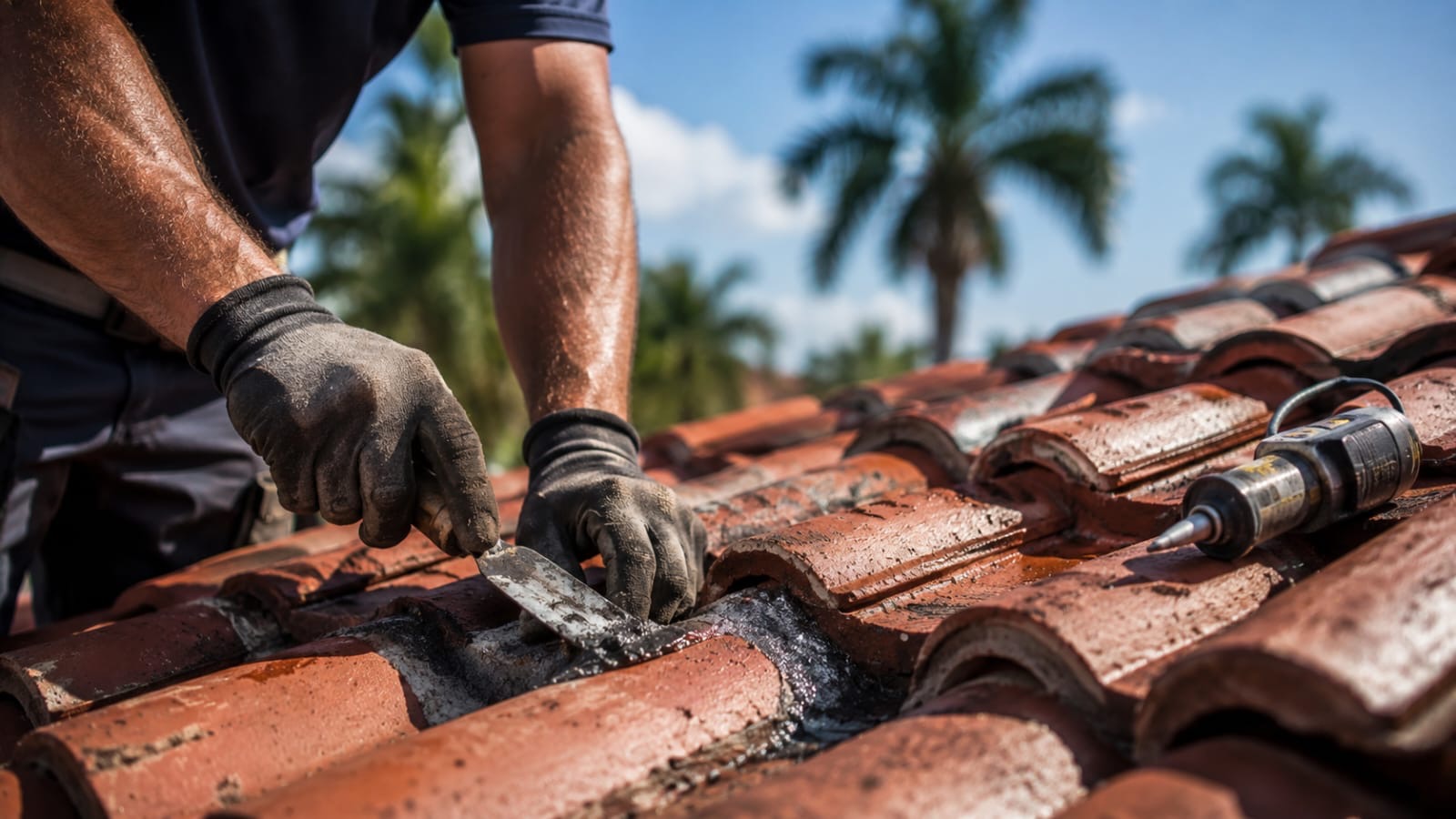
Repair makes sense when the damage is local and recent, and the rest of the roof is sound: a few wind-lifted shingles, a handful of slipped or broken tiles, a failed pipe boot, or one flashing leak at a wall or skylight. In the High-Velocity Hurricane Zone (Miami-Dade and Broward), repairs must use roofing components that have a product approval (FBC 1521.2), so even a small fix should be done with approved materials (FBC Chapter 15).
Fixr’s 2026 data puts the national average roof repair at $1,150, with most jobs between $400 and $1,900. By material, Fixr lists $150 to $1,500 for asphalt shingles, $300 to $1,100 for flat roofs, $500 to $2,000 for metal and $500 to $2,500 for clay or concrete tile (Fixr). These are national ranges, not our prices, and HVHZ work usually sits in the upper half. For leaks specifically, see our line-item leak repair cost guide.
Seven signs a roof is done
- Age near the end of the material’s range. Shingles in Miami’s heat sit at the short end of published lifespans, while tile and metal last longer. Our lifespan guide compares the sources.
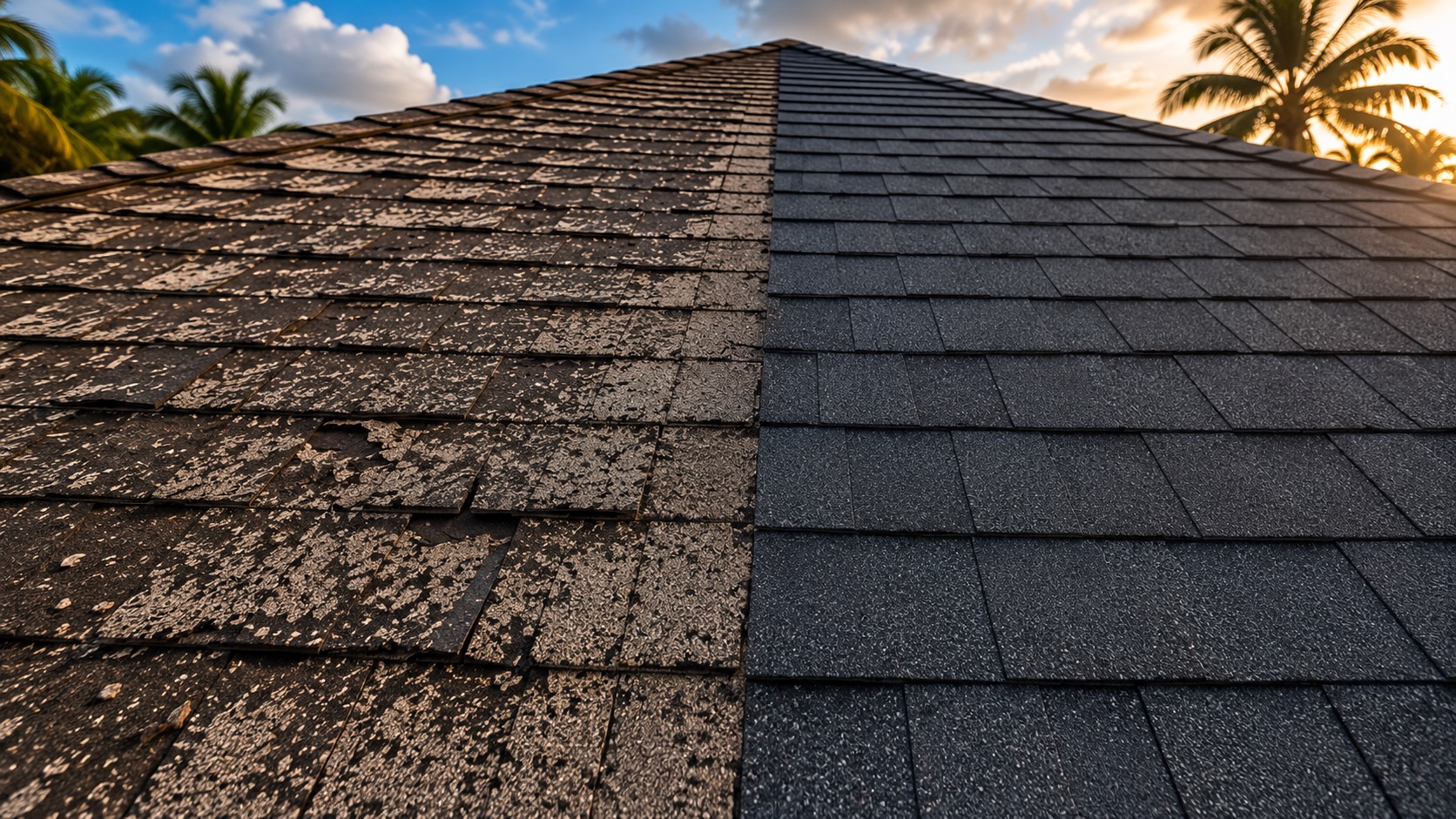
- Granule loss across the whole field. Bare patches and granules in the gutters mean the shingles’ UV protection is going everywhere at once.
- Leaks in different places, again and again. One leak is a repair. Several, especially on a tile roof, usually mean the underlayment beneath has reached the end of its life (why tile roofs leak).
- Soft or sagging deck. A dip in the roofline or spongy spots means wet or rotted wood. In the HVHZ, a new roof cannot go over sheathing that is “water soaked or deteriorated,” and that wood has to be replaced (FBC 1521.5).
- Cracked or slipped tile all over, or tile you can’t match. TRI Alliance notes that while most concrete and clay tiles are still in production, “some may no longer be manufactured.” If no tile “can sufficiently interlock and seat with the existing tiles,” options are harvesting tile from another roof plane or “a complete roof replacement” (TRI Alliance 2021-02).
- Daylight, damp insulation or a musty attic. Water is already getting past the roof.
- An insurer asking about roof age. Covered in detail below.
How does Florida’s 25% rule affect the decision?
The Florida Building Code limits repairs on existing roofs: “Not more than 25 percent of the total roof area or roof section” may be repaired, replaced or recovered in any 12-month period unless the entire roof or section is brought up to the current code (Existing Building Code 706.1.1; in the HVHZ, 1521.4) (FBC Existing Building, Chapter 7).
There is an exception, written into state law in 2022 by SB 4-D (chapter 2022-269). If the roof or section was built, repaired or replaced under the 2007 Florida Building Code or later, and 25 percent or more is being worked on, “only the repaired, replaced, or recovered portion” has to meet the current code. Local governments cannot amend that exception (s. 553.844(5), F.S.; SB 4-D).
In practice, the year of the last roof permit matters. On a roof permitted under the 2007 code or later, a large repair stays a repair. On an older roof, a repair that grows past a quarter of a section within 12 months can require the whole section to be redone to current code, and the repair quote should say so up front. Our FAQ on Florida roofing laws and the code edition guide cover the details.
What about insurance and roof age?
Florida law sets a floor for how insurers treat older roofs. An insurer may not refuse to issue or renew a homeowner’s policy on a roof “less than 15 years old” solely because of its age. For a roof 15 years or older, the insurer must let you have the roof inspected by an authorized inspector, at your expense, before requiring replacement. It also may not refuse solely because of roof age if that inspection shows “5 years or more of useful life remaining” (s. 627.7011(5), F.S.).
That makes an inspection worth doing before you decide. If the report shows five or more years left, a repair may keep the policy in place. If it doesn’t, replacement may be the only way to keep coverage. Each carrier applies its own underwriting on top of the statute. See roof age and the 15-year rule.
What does a replacement add that a repair can’t?
A replacement brings the whole roof up to the code in effect, and Florida law adds specific upgrades. A roof replacement on a site-built single-family home must include a secondary water barrier and strengthened roof-deck attachment. In the wind-borne debris region, homes insured for $300,000 or more also get roof-to-wall connections when the work can be done at the gable ends or corners for no more than 15 percent of the roof replacement cost (s. 553.844(3), F.S.). FEMA likewise recommends installing an upgraded underlayment whenever the entire roof covering is replaced (FEMA P-2181, 3.3.1).
Those features are what a wind mitigation inspector records, so a new roof often improves the insurance picture too (what a wind mitigation inspection looks at). A repair keeps the old deck nailing and underlayment in place, however good the patch is.
How do I compare the two numbers?
Fixr’s rule of thumb is to repair when there have been no ongoing problems, the repair costs less than half of a replacement, and the roof has more than half its life left; otherwise replacement may save money over time (Fixr). For scale, our turnkey replacement prices for a typical home with about 2,000 to 2,800 sq ft of roof area are $14,000 to $26,000 for architectural shingle, $30,000 to $55,000 for standing-seam metal and $35,000 to $70,000+ for concrete or clay tile. The cost guide explains what moves those ranges, and the roof cost calculator gives a first estimate for your roof.
Tile roofs have a middle option. When the tile is still good but the underlayment is worn, the tile can be lifted, new underlayment installed and the tile set back. See lift-and-relay vs. replacement.
What to ask for before you decide
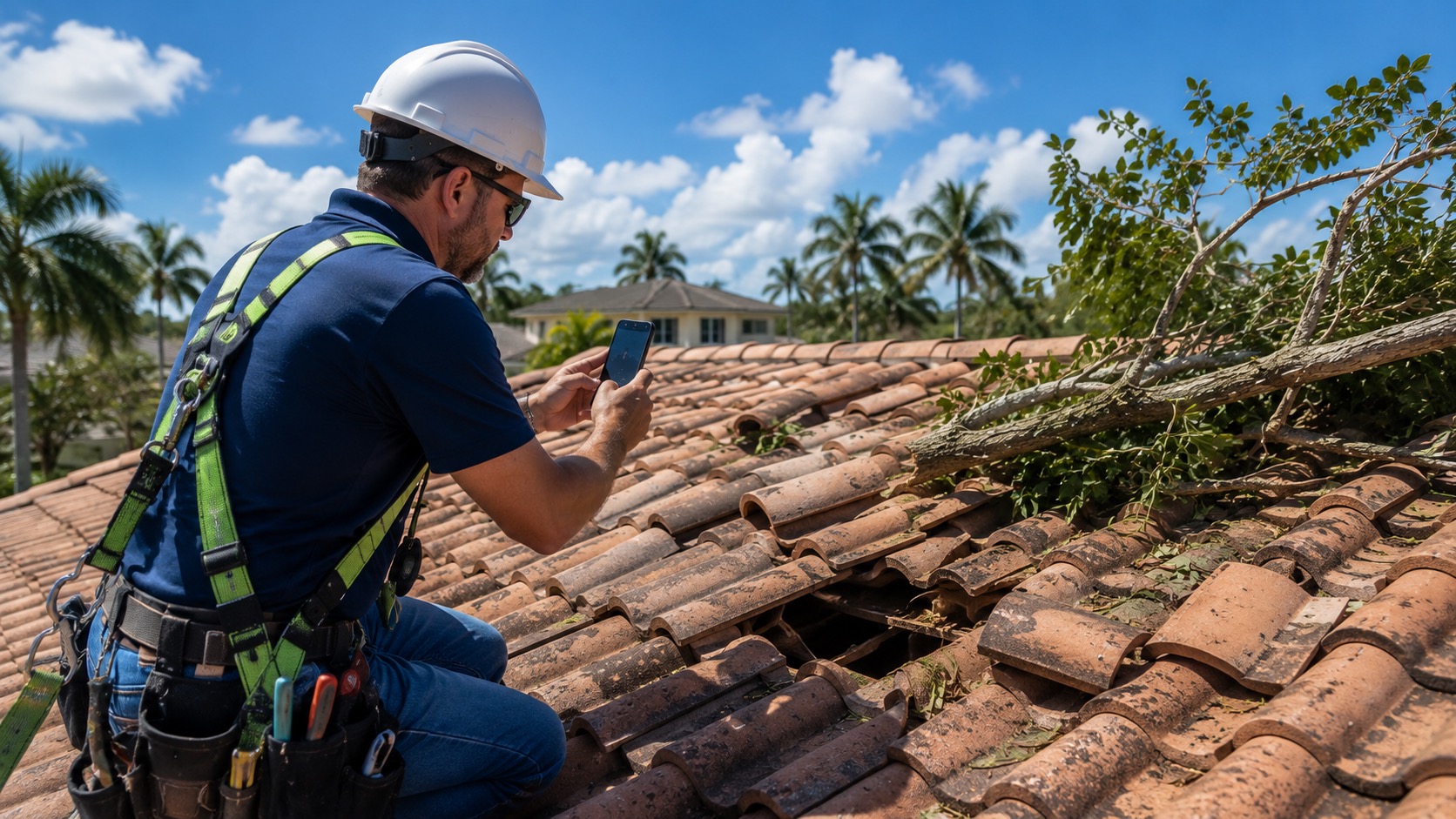
- Photos of the failure and of the rest of the roof, not just the leak.
- The last roof permit date, so the 25% rule question is answered.
- A written repair scope and a written replacement scope, priced separately.
- For tile, whether matching tile is available.
- If the roof is 15 or older, an inspection that states remaining useful life.
Next step
Get an inspection that answers the repair-or-replace question in writing, with photos. Art’s Roofing & Construction (Florida Certified Roofing Contractor CCC1333598) inspects and works on tile, metal, shingle and flat roofs in Miami-Dade, Broward and Palm Beach. See roof repair and roof replacement, or request a free inspection.
Sources
- Fixr — How Much Does It Cost to Repair a Roof? (updated January 21, 2026) (fixr.com)
- Florida Building Code, Existing Building, 8th Edition (2023), Chapter 7 Alterations—Level 1 (Sections 706.1.1, 706.3) (codes.iccsafe.org)
- Florida Building Code, Building, 8th Edition (2023), Chapter 15 Roof Assemblies and Rooftop Structures (Sections 1521.2, 1521.4, 1521.5) (codes.iccsafe.org)
- Florida Statutes (2026) s. 553.844 — Windstorm loss mitigation; requirements for roofs and opening protection (flsenate.gov)
- Florida Senate — SB 4-D (2022D), Building Safety, ch. 2022-269 (flsenate.gov)
- Florida Statutes s. 627.7011 — Homeowners' policies (roof age, authorized inspector), 2026 (flsenate.gov)
- TRI Alliance Technical Brief #2021-02 — Tile Replacement Considerations for Tile Roofs (tileroofing.org)
- FEMA P-2181 Fact Sheet 3.3.1 — Roof Systems: Sloped Roofs (March 2022) (fema.gov)