Updated: October 20, 2026
Shade trees cool a house, but a canopy over the roof adds steady wear: leaves and seed pods pile up in valleys and gutters, shade keeps the surface damp, and branches can scrape or break roofing in a storm. You manage that with regular roof checks and proper pruning. In Coral Gables, much of that pruning needs a city permit, so plan it before you call a tree crew.
This guide covers what the canopy does to a roof, the upkeep that helps, and the city and state rules as of October 20, 2026. Tree rules change and depend on the tree, so confirm your case with the city’s Greenspace Management Division before any cutting.
How overhanging trees wear on a roof
| Effect | What happens | What you can check from the ground |
|---|---|---|
| Debris in valleys and gutters | Leaves, twigs and seed pods collect where roof slopes meet and at the eaves. Wet debris holds water against the roof and can push water back under the edge. | Gutters overflowing in rain, plants growing in gutters, dark piles in valleys |
| Constant shade | Shaded slopes dry slowly after rain, which favors algae, moss and lichen, especially on north faces. | Dark streaks or green growth on shaded slopes |
| Abrasion | Branches that touch the roof rub in the wind and can wear the surface or loosen tile and shingles. | Limbs resting on or just above the roof |
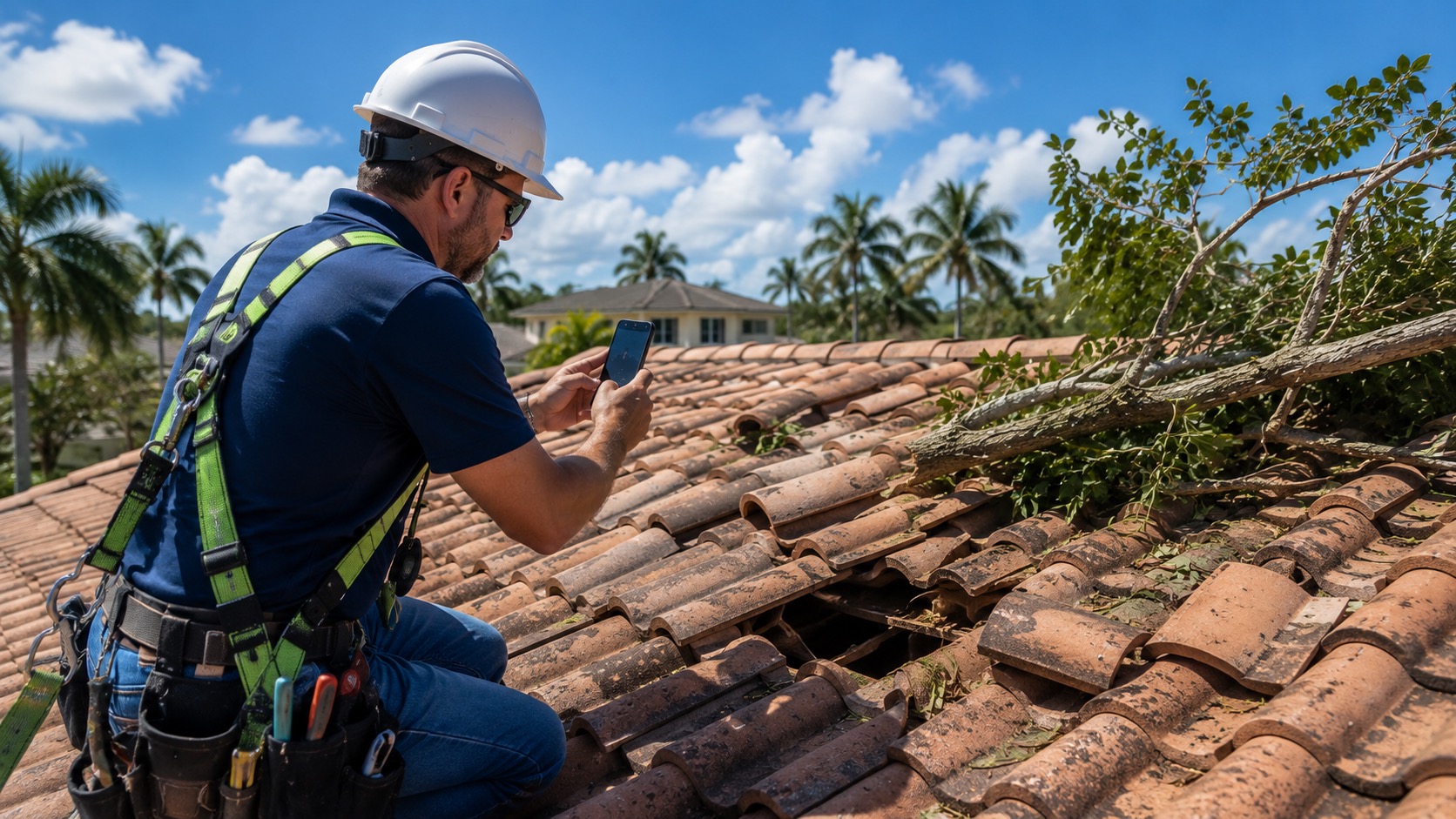
| Storm limbs | Dead, weak or overextended limbs over the house can break in high wind and puncture or crack the roof. | Dead wood, hanging limbs, splits in the canopy over the house |
| Fallen fronds and fruit | Palm fronds and heavy fruit land on the roof and in gutters. | Fronds lodged on the roof or in gutters |
Damage from debris and abrasion builds slowly, so it shows up in places that are hard to see. Valleys and roof-to-wall joints are common leak points under a canopy.
Upkeep that helps
- Look from the ground after storms and before hurricane season. Use binoculars or photos from a window. Stay off the roof. Wet tile, moss and debris are slippery, and tile can break underfoot. Leave the climbing to professionals.
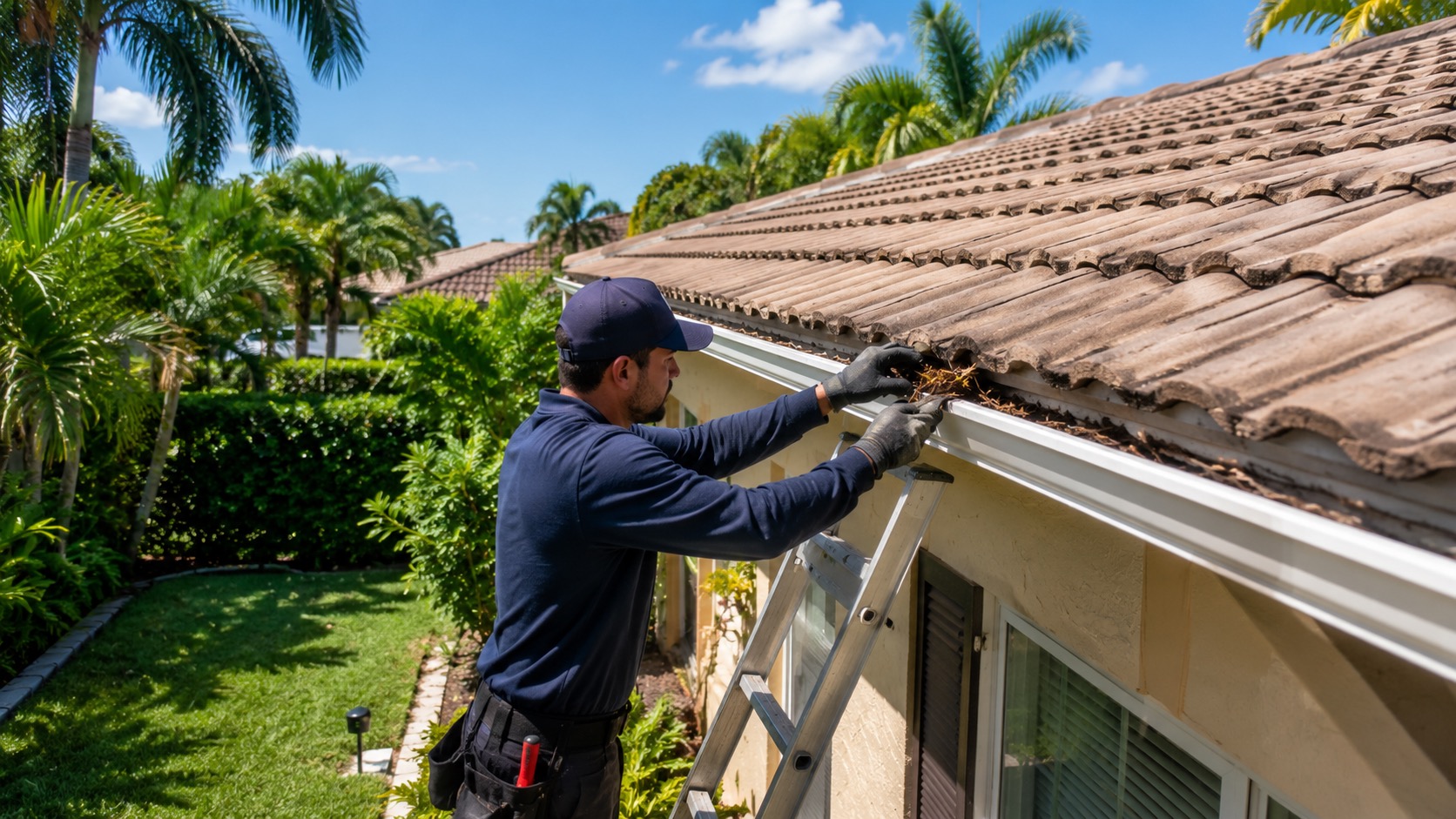
- Have gutters and valleys cleared by someone equipped to do it. How often depends on the trees over your roof. A heavy-shedding oak needs more attention than a few palms.
- Get a professional roof inspection if you see slipped or cracked tile, lifted shingles, stains on ceilings, or debris that has sat in a valley for a long time. The roof inspection guide explains what a roofer checks.
- Treat biological growth by the roofing manufacturer’s care instructions. Some cleaning methods can damage some roof coverings, so check before anyone cleans the roof.
- Prune for clearance and structure. A qualified arborist can raise or reduce limbs over the house without harming the tree. That is where the permit rules below come in.
For a broader routine, see the South Florida roof maintenance checklist and the hurricane season roof checklist.
When Coral Gables requires a tree permit
Coral Gables regulates trees through Chapter 82 (Vegetation) of the City Code, administered by the Public Works Greenspace Management Division. The key points:
- What counts as a tree. Section 82-28 defines a tree as a woody or fibrous plant with a trunk of 4.5 inches or more in diameter at breast height (DBH, measured 4.5 feet above grade) or 12 feet or more in overall height. Palms are included.
- Removal, relocation or modification needs a permit. Under Section 82-29(a), no one may modify, cut down, destroy, remove or move a tree without first getting a permit, “subject to any applicable state law” (see the state exemption below).
- Pruning on private property. Under Section 82-29(d), pruning limbs 10 inches or more in diameter needs a tree permit. Branches 4 inches or more must be pruned by a qualified tree trimmer, defined as someone who is, or works under the direction of, an ISA Certified Arborist, or who holds a county or municipal tree trimmer license in Florida. Smaller pruning can be done by the owner, with hired help if needed.
- Specimen trees. A healthy tree with any trunk of 18 inches DBH or more is a specimen tree (with listed exceptions, such as some fruit trees). For specimen trees, the code’s definition of “tree modification” also covers cutting certain roots.
- Tree abuse is prohibited. Section 82-28 counts topping or hatracking, flush cuts, and pruning that doesn’t follow ISA Best Management Practices and ANSI A300 as tree abuse. Abuse that kills or effectively destroys a tree is treated as a removal without a permit.
- City trees in the swale. Under Section 82-29(e), pruning trees on public property and rights-of-way, including the swale in front of many Gables homes, is prohibited unless an ISA Certified Arborist files a permit application and the city approves the work in advance. Don’t have a crew cut back a swale tree that hangs over your roof without that approval.
How the city’s application works
The city’s Landscape Permits page sends applicants to the EnerGov self-service portal to apply under “Tree Removal / Relocations / Pruning.” Depending on the request, it lists an application form, an arborist report, a survey or sketch and, for large-branch pruning, a certificate of liability insurance. Questions go to PWGreenspace@coralgables.com.
For large-branch pruning (over 10 inches), the city’s authorization form says permits go only to full tree service companies, the work must be done or directly supervised by an ISA Certified Arborist, and the application must reach Greenspace at least 10 workdays before the planned work date.
When a removal requires replacement trees, the Landscape Permits page says replacement is based on the canopy lost. Trees of 24 inches DBH or more require double mitigation, and where the site can’t fit the replacements, the city charges a tree trust fund contribution of $1,500 per 500 square feet of canopy deficit.
Historic properties
On a designated historic landmark or in a historic district, landscape features designated as significant are also protected by the Zoning Code. Section 8-110 limits when a Certificate of Appropriateness can be granted to remove them. One of the allowed reasons is vegetation that is diseased, injured or in danger of falling.
The state exemption for high-risk trees (s. 163.045)
Florida Statutes s. 163.045 limits what local governments can require for trees at single-family homes:
- Who it covers. “Residential property” means a single-family, detached building on a lot actively used for single-family residential purposes. Condos and commercial property are not covered.
- What you need. “Documentation” means an on-site tree risk assessment done under the ISA Best Management Practices – Tree Risk Assessment (Second Edition, 2017) and signed by an ISA Certified Arborist or a Florida-licensed landscape architect.
- What it does. If that documentation shows the tree poses an unacceptable risk to persons or property, a local government may not require a notice, application, approval, permit, fee or mitigation for pruning, trimming or removing it. It may not require replanting either. A tree is an unacceptable risk when removal is the only means of bringing its risk below moderate.
- Limits. It does not apply to mangrove protection, which has its own state rules. The statute covers a tree on the residential property, so city-owned swale trees still go through the city.
Coral Gables’ Chapter 82 permit requirement is written “subject to any applicable state law,” but the code doesn’t say how the city handles 163.045 claims. Before relying on the exemption, get the arborist’s written assessment first, keep it, and confirm with Greenspace Management how the city wants to be notified, if at all. A tree that is merely messy or shades the roof is not an “unacceptable risk” under the statute.
What about Miami-Dade County permits?
Miami-Dade County lists Coral Gables among the cities with their own tree ordinance, so a county permit generally isn’t needed for typical private-property work in the city. The county page lists exceptions where county authorization is still required, such as county-designated Natural Forest Communities, trees under specimen tree covenants in favor of the county, county-owned land and rights-of-way. Mangroves and trees in wetlands have separate contacts.
Protecting trees during roof work
If you are re-roofing, the city’s definition of tree abuse also covers damage to roots from machinery, soil compaction, and piling trash or construction debris within six feet of a tree. Talk with your roofer about where the debris container and material pallets will go. You can also mark the root zones of large trees near the driveway or drop zone.
Hire an arborist, not a roofer, for the tree
Pruning over a roof means working at height with heavy limbs above a fragile surface. ISA notes that tree work, especially on large trees, should be done only by people trained and equipped to work safely in trees. In Coral Gables, the larger cuts legally require a qualified tree trimmer or arborist anyway.
- Don’t climb onto the roof or into the tree yourself to cut limbs, even small ones.
- Stay away from power lines. Miami-Dade County warns never to prune near electrical or utility lines and to contact Florida Power & Light instead.
- Ask the arborist for their ISA certification number, proof of insurance and whether they will pull the city permit.
Once the tree work is done, have a roofer inspect any spots where limbs were touching the roof or debris had collected.
Next step
If branches have been rubbing your roof or debris has been sitting in the valleys, start with a roof inspection. You’ll know what needs repair before or after the arborist’s work. Read about our roof repair service, see our Coral Gables page, or request a free estimate.
Sources
- City of Coral Gables Code of Ordinances, Chapter 82 Vegetation (Sections 82-28, 82-29, 82-31) (library.municode.com)
- City of Coral Gables Public Works: Landscape Permits (tree and swale permits) (coralgables.com)
- City of Coral Gables Greenspace Management: Authorization for Private Contractor Pruning of Large Diameter (over 10 inches) Branches (coralgables.com)
- City of Coral Gables Zoning Code, Article 8 Historic Preservation (Sections 8-106, 8-110) (codehub.gridics.com)
- Florida Statutes (2026), s. 163.045 Tree pruning, trimming, or removal on residential property (flsenate.gov)
- Miami-Dade County: Tree Removal or Relocation Permits (miamidade.gov)
- Miami-Dade County: Choosing and Caring for Your Tree (miamidade.gov)
- TreesAreGood.org (International Society of Arboriculture): Why Hire an Arborist? (treesaregood.org)