Updated: October 20, 2026
A TPO or EPDM roof that lifts, balloons or ripples in the wind is telling you something about how it is held down. Some movement can be normal in a mechanically fastened system. A membrane that stays inflated, flaps at an edge, or pulls loose around a curb is not normal, and it should be looked at before the next strong wind.
Safety first: don’t walk on a loose or billowing membrane, especially in wind. It can move underfoot, hide damaged areas, and pull away near roof edges. Watch and photograph it from the ground, a window or a neighboring building, and leave rooftop access to a roofer with fall protection.
Is some billowing normal?
It depends on how the roof is attached. Single-ply membranes, the TPO and EPDM family, can be “loosely laid, adhered mechanically, or adhered with caulk or heat,” as CRRC puts it (CRRC). Billowing questions usually come down to the two attachment types below.
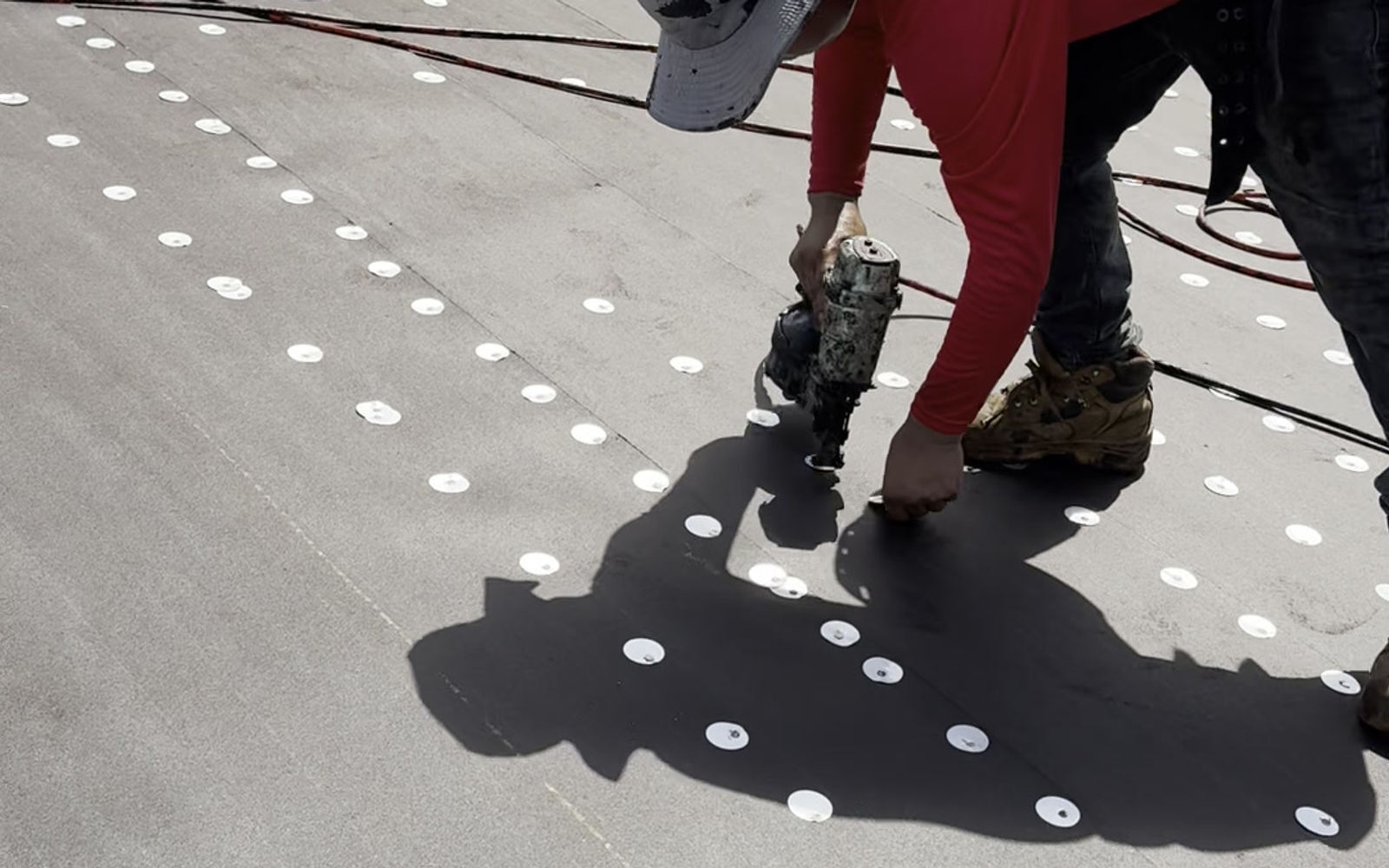
- Mechanically fastened: The sheet is fastened with screws and plates in rows, usually at the seams, and is free between the rows. NRCA’s technical staff note that such a membrane “likely will flutter when experiencing a pressure differential,” and call that fluttering “evidence of air infiltration into the assembly” (Professional Roofing, Aug. 2014). Some lift between fastener rows on a windy day can be expected with this design.
- Fully adhered: The sheet is glued or self-adhered across its whole area. It should not billow. A raised or “pillowed” area on an adhered roof points to an adhesion failure or trapped air or moisture.
If you don’t know which type you have, the permit file or the original approval (NOA) will say. So will a roofer looking at the seam pattern.
What makes a membrane come loose
Attachment failure
Fasteners pull out of a weak or corroded deck, plates are missing or spaced too far apart, or adhesive lets go. That can happen because it was applied off-spec, because the surface was wet or dirty, or because the substrate below it has deteriorated. Approvals in the High-Velocity Hurricane Zone tie fastener spacing to tested withdrawal values. One TPO approval states that if fastener resistance is lower than required, a revised spacing signed and sealed by a Florida engineer, architect or registered roof consultant may be submitted, based on TAS 105 field tests and RAS 117 calculations (NOA 23-0616.04).
Seam failure
An open seam lets wind get under the sheet and water into the insulation. TPO seams are hot-air welded. EPDM seams rely on tape and adhesive (CRRC). Each fails in its own way: unbonded or burned welds on TPO, and tape that has lost adhesion on EPDM.
Wind uplift at perimeters and corners
Wind suction is strongest at the roof’s edges and corners. That is why approvals require extra fastening there. The same NOA says fastener densities “shall be increased for both insulation and base sheet” in perimeter and corner areas, calculated under RAS 117 and/or RAS 137. Edge metal is part of the system too. In the HVHZ, flashing and edge terminations follow RAS 111 (FBC §1514.2). Outside it, metal edge systems on membrane roofs are tested to ANSI/SPRI ES-1 (FBC §1504.5). A loose coping or edge strip can let wind peel the membrane from the edge inward.
Air getting in at perimeters and penetrations
When wind lifts the sheet, the space under it pulls in air from wherever it can: gaps at the walls, unsealed penetrations, open curbs, or the building interior through the deck. NRCA has written that “mechanically attached single-ply membrane roof systems do not necessarily function as adequate continuous air barriers” (Professional Roofing, June 2010). Sealing these air paths is often part of the fix.
Why it matters
- Progressive failure. Each cycle of lifting stresses the fasteners, the seams and the edge details. A loose area can grow during a single storm.
- Water in the insulation. An open seam or torn flashing lets rain into the insulation, where it can spread well beyond the visible damage.
- Insurance and warranty questions. Warranties set their own wind terms. Johns Manville’s guarantee summary, for example, covers “repairs due to local wind gusts less than or equal to 55 mph,” excludes natural disasters including windstorm and hurricane, and excludes repairs made after completion “unless performed in a manner acceptable to JM by an approved JM contractor” (JM RS-7396). Check your warranty and notify the manufacturer before anyone touches a warranted roof. See roofing warranties explained. If a storm caused the damage, our after-the-storm guide explains how to document it.
What an assessment looks at
A roofer or roof consultant usually checks:
- Which attachment system is installed, and which approval it was permitted under.
- Where the loose area is: the field, the perimeter, a corner, or around a curb or penetration. This points to the cause.
- Seams: probing welds on TPO and checking tape or adhesive bond on EPDM.
- Fasteners and plates: backed-out screws, missing plates, or plates tearing through the sheet.
- Edge metal, copings and terminations: whether they are secured and sealed.
- The deck and insulation: whether they are wet or deteriorated. A test cut may be needed, and it is then patched.
- Air paths at walls, penetrations and rooftop equipment curbs.
The answer should be in writing, with photos of each problem area.
Repair, re-attachment or replacement?
| Situation | Typical direction |
|---|---|
| A few open seams or a torn flashing; deck and insulation dry | Repair with the membrane’s own seam method: welded patches for TPO, tape or adhesive for EPDM |
| A localized area lost its fasteners or adhesion; deck sound | Re-attach the area (added fasteners and cover strips, or re-adhering) and seal the air paths |
| Edge metal or coping loose | Re-secure or replace the edge system to the applicable standard, then repair the membrane at the edge |
| Widespread loss of attachment, wet insulation, or a deck that won’t hold fasteners | Replacement of the roof or roof section, with the deck repaired and a currently approved assembly |
Two code limits in Miami-Dade and Broward affect the choice. First, the HVHZ reroofing rules limit how much of a roof can be “repaired, replaced or recovered in any 12-month period” to 25 percent of the roof area or roof section, unless the whole roof system or section is redone (FBC §1521.4). Second, before a new roof is bonded over an existing membrane, the existing membrane “shall be tested in compliance with TAS 124 for uplift resistance” (FBC §1521.10). Both are in the 2023 Florida Building Code, 8th Edition, Chapter 15. How they apply to your building is settled at permitting. Our guide to roof permits by county explains that process.
Next step
If your membrane is lifting, keep people off the roof and take photos and short videos from a safe spot, ideally on a windy day. Then have it assessed. Art’s Roofing & Construction installs and repairs TPO and modified bitumen roofs on flat and low-slope buildings across Miami-Dade, Broward and Palm Beach. See our commercial roofing service or contact us to schedule an inspection.
Sources
- Professional Roofing (NRCA) — Tech Today, August 2014 (professionalroofing.net)
- Professional Roofing (NRCA) — Tech Today: Air leakage in mechanically attached single-ply membranes is a concern, June 2010 (professionalroofing.net)
- 2023 Florida Building Code, Building, 8th Edition — Chapter 15 Roof Assemblies and Rooftop Structures (UpCodes) (up.codes)
- Miami-Dade NOA 23-0616.04 — GAF EverGuard TPO Single Ply Roofing Systems over Steel Decks (miamidade.gov)
- Cool Roof Rating Council — Low-Sloped Roofing Product Types (coolroofs.org)
- Johns Manville — Understanding Your JM Peak Advantage Guarantee (RS-7396 10-25) (jm.com)