Updated: October 20, 2026
TPO, modified bitumen and EPDM can all keep water out of a flat or low-slope roof. They differ in what the sheet is made of, how the seams are joined, how the system is held down and how it handles sun. In Miami-Dade and Broward, the deciding question is usually not “which membrane?” but “which approved assembly fits this deck, this wind load and this drainage?”
This guide covers the three side by side. For the bigger picture on flat roofs (budget drivers, recover versus tear-off), see our flat and low-slope roofing overview.
What each membrane actually is
- TPO (thermoplastic polyolefin) is a single-ply sheet. The Cool Roof Rating Council describes it as “a blend of polymers that can contain flame-retardants or UV absorbers,” with seams that “can be melded together using hot-air welding” (CRRC). The Florida Building Code lists TPO under the ASTM D6878 standard.
- Modified bitumen is asphalt modified with a polymer, most commonly SBS or APP, made into reinforced sheets. It is built up in plies: a base sheet, sometimes an interply, and a cap sheet. CRRC notes the sheets “are applied to the roof by torch, mechanical adhesion, or with an adhesive.” The code lists it under ASTM D6162, D6163, D6164, D6222, D6223, D6298 or D6509.
- EPDM is a synthetic rubber, which makes it a thermoset. It cannot be re-melted and welded the way TPO can. CRRC: “Adhesives and tape are used to seal seams.” The code lists it under ASTM D4637.
The ASTM references come from Florida Building Code, Building, 8th Edition, §1507.11.2 and Table 1507.12.2. That is the edition in force on the date of this article. The 9th Edition is scheduled to take effect on December 31, 2026.
Side-by-side comparison
Every number below comes from a cited document. Where a property varies by product, the cell says so rather than inventing a figure.
| TPO | Modified bitumen | EPDM | |
|---|---|---|---|
| Composition | Thermoplastic polyolefin single ply, usually reinforced (ASTM D6878) | Polymer-modified asphalt sheets (SBS or APP) laid in two or more plies | Synthetic rubber (thermoset) single ply (ASTM D4637) |
| Seams | Hot-air welded. One approval calls for laps of at least 3 in. with welds at least 1½ in. wide by machine and 2 in. by hand (NOA 23-0616.04) | Overlapping sheets bonded with the same method used to install them: torch, hot asphalt, cold adhesive or self-adhesion | Seam tape and adhesives, plus primers and cleaners as the system requires |
| Attachment (examples from approvals) | Fully adhered with bonding adhesive, self-adhered, or mechanically fastened through the insulation to the deck | Hot asphalt, cold adhesive, torch, or a mechanically attached base sheet with adhered plies above | Fully adhered, or mechanically attached |
| Heat and UV | Formulations can include UV absorbers. Some product lines are sold as designed “for advanced protection against heat aging and UV degradation” | DOE: SBS sheets “must be coated to prevent rapid ozone and UV degradation”; leaving APP unsurfaced “is not recommended” | Typically black, so it absorbs more solar heat unless a white or coated version is used |
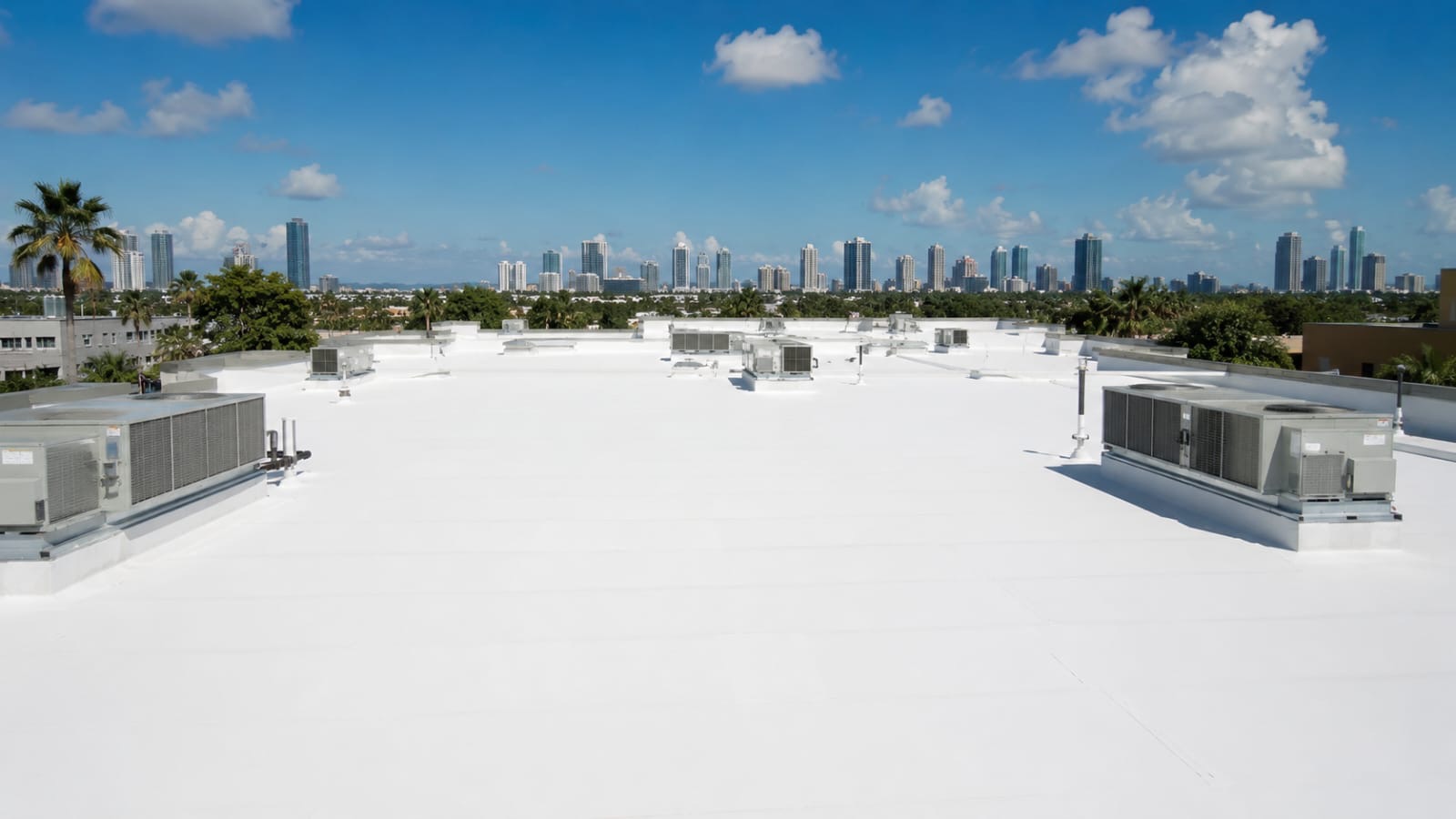
| Reflectivity | DOE: “typically white and reflect sunlight well” | Set by the surfacing. Granule-surfaced, white-granule and factory-coated cap sheets are made | DOE: “typically black, and must be formulated differently or coated to make them reflective” |
| Ponding tolerance | None of the three is a fix for ponding. The code requires drainage within 48 hours, and manufacturers’ warranty exclusions differ (see below) | Same | Same |
| Repairability | Patches are welded with compatible TPO, so the old sheet must still weld | Patches are built in compatible plies using the same application method | Patches use EPDM with seam tape or adhesive |
| Typical uses | Large open commercial roofs where a white surface is wanted | Multi-ply systems with granule surfacing, on both commercial roofs and smaller flat roofs on homes | Commercial roofs, especially where black is acceptable or a white version is specified |
The DOE quotes come from its Guidelines for Selecting Cool Roofs. That guide dates from July 2010, so check current product data for exact reflectance values. Rated values for individual products are listed in the CRRC directory. We will cover reflectance, emittance and SRI in more detail in our cool roofs guide.
Why “HVHZ-approved TPO” isn’t a complete answer
In the High-Velocity Hurricane Zone, which covers Miami-Dade and Broward, the code requires that “all roof assemblies, roof coverings and roof systems shall have product approval.” It adds that “only those components listed within the roofing assembly product approval shall be approved for use” (FBC §1515.1 and §1515.1.1). Fasteners, stress plates and insulation fasteners need their own approval too (§1520.4).
An approval is issued for a specific assembly on a specific deck type. A few current Miami-Dade NOAs show how much the deck changes the result:
| Approval | Membrane | Deck | Maximum design pressure listed |
|---|---|---|---|
| NOA 23-0616.04 (GAF) | TPO | Steel | −105 psf |
| NOA 26-0210.10 (Elevate) | TPO | Concrete | −500 psf |
| NOA 23-0801.07 (Elevate) | EPDM | Steel | −52.5 psf |
| NOA 23-0801.08 (Elevate) | EPDM | Concrete | −360 psf |
| NOA 26-0210.04 (Elevate) | Modified bitumen (APP/SBS) | Concrete | −462.5 psf |
These are the maximums for the strongest system in each document. Individual system types inside the same NOA list lower values. The table doesn’t rank membranes. It shows that the deck, insulation, fastening pattern and adhesive decide what an assembly can resist. The approvals also set conditions. Perimeter and corner fastening must be increased “as calculated in compliance with Roofing Application Standard RAS 117 and/or RAS 137.” Weak decks may need field fastener-withdrawal testing under TAS 105. The NOA has to be available on the job site for the building official.
So the useful question for any proposal is: which NOA or Florida Product Approval, which system number in it, and does its design pressure meet the calculated pressure for your roof’s field, perimeter and corners? Outside the HVHZ (Palm Beach County, for example), the general Chapter 15 rules and Florida Product Approval apply instead. Your permit documents still have to show an approved, tested assembly.
Ponding: none of them is a drainage fix
NRCA defines ponding as water “that remains more than 48 hours after precipitation under conditions conducive to drying” (NRCA glossary). The Florida Building Code’s definition of positive roof drainage uses the same 48-hour window. Manufacturers handle ponding differently in their warranties. Johns Manville’s guarantee summary, for example, excludes “damage due to improper drainage (ponding water) of all system with the exception of TPO and PVC membranes which is available with prior approval” (JM RS-7396). That is one manufacturer’s terms. Read the exclusions in the specific warranty you are offered.
If your roof holds water, choosing a different membrane won’t solve it. The slope and drains have to be corrected. Our ponding water guide covers causes and fixes.
When each is typically considered
This is general guidance, not a recommendation for your building. A designer or roofer should base the choice on the deck, the approvals available for it, drainage, rooftop equipment and the warranty you want.
TPO
- You want a white, reflective surface from the factory.
- The roof is large and open, and welded seams that can be probed and tested are a priority.
- An approved TPO assembly exists for your deck at the design pressure you need.
Modified bitumen
- You want a multi-ply system, with flashings built from the same asphalt materials.
- A granule-surfaced finish suits the building, in standard or white-granule or coated versions if you want it more reflective.
- Ask how it will be applied. Torch application uses open flame, so ask how the crew will protect walls, curbs and other combustible areas, or whether a cold-adhesive or self-adhered system is approved for your deck.
EPDM
- The building already has EPDM and a like-for-like repair or replacement is being priced.
- Heat gain matters less, or a white or coated EPDM is specified.
- An approved EPDM assembly exists for your deck. As the table shows, the listed maximum pressure varies widely between decks.
What to ask before you sign
- Which approval (NOA or FL number) and which system type within it does the proposal use? Does its design pressure meet the calculated pressures for the field, perimeter and corners?
- Is it a tear-off or a recover? In the HVHZ, an existing membrane must pass a TAS 124 uplift test before a new roof is bonded over it (FBC §1521.10).
- How will water leave the roof, and does the proposal address existing ponding?
- Which warranty applies (manufacturer material, system or NDL, plus the contractor’s workmanship warranty), and what does it exclude? See manufacturer vs workmanship warranties.
Next step
Art’s Roofing & Construction installs TPO and modified bitumen systems on flat and low-slope roofs in Miami-Dade, Broward and Palm Beach, and NDL manufacturer warranties are available on qualifying systems. To have your roof assessed and the options compared for your deck, see our commercial roofing service or request a free estimate.
Sources
- Cool Roof Rating Council — Low-Sloped Roofing Product Types (coolroofs.org)
- U.S. Department of Energy — Guidelines for Selecting Cool Roofs (July 2010) (energy.gov)
- 2023 Florida Building Code, Building, 8th Edition — Chapter 15 Roof Assemblies and Rooftop Structures (UpCodes) (up.codes)
- Miami-Dade NOA 23-0616.04 — GAF EverGuard TPO Single Ply Roofing Systems over Steel Decks (miamidade.gov)
- Miami-Dade NOA 26-0210.10 — Elevate UltraPly TPO & TPO XR Single Ply Roof Systems over Concrete Decks (miamidade.gov)
- Miami-Dade NOA 23-0801.07 — Elevate EPDM Single Ply Roof Systems over Steel Decks (miamidade.gov)
- Miami-Dade NOA 23-0801.08 — Elevate EPDM Single Ply Roof Systems over Concrete Decks (miamidade.gov)
- Miami-Dade NOA 26-0210.04 — Elevate Modified Bitumen Roof Systems over Concrete Decks (miamidade.gov)
- Johns Manville — Understanding Your JM Peak Advantage Guarantee (RS-7396 10-25) (jm.com)
- NRCA Roofing Glossary — Ponding (nrca.net)