
Updated: October 20, 2026
Clay and concrete tile both work well in South Florida when they are installed as an approved system: the right tile, the right underlayment, and the attachment method its product approval lists for your roof’s wind pressures. The tile sheds most of the water and takes the sun; the underlayment beneath it is the layer that usually wears out first; and the house has to be able to carry the weight.
Clay or concrete: what’s the difference?
Both are rigid, noncombustible tiles made in flat, low and high (“S” or barrel) profiles. Under the Florida Building Code, clay roof tile must meet ASTM C1167 and concrete roof tile ASTM C1492 (Sections 1507.3.4 and 1507.3.5); in the High-Velocity Hurricane Zone, concrete tile is tested under TAS 112 instead (Section 1523.6.5.2). The practical differences:
| Clay tile | Concrete tile | |
|---|---|---|
| Material | Fired clay, often glazed or with a matte ceramic finish | Cement and aggregate, color through the body or on the surface |
| Maintenance (per the Tile Roofing Industry Alliance) | Glazed or matte clay is “essentially maintenance-free" | "Very low maintenance”; temporary efflorescence can appear and usually fades |
| Color over time | Color may soften slightly with long exposure | Color may soften slightly with long exposure |
| Weight | Varies by profile; check the manufacturer’s data | Varies by profile; some makers offer lighter-weight versions |
| Fire | Noncombustible; Class A rating per TRI | Noncombustible; Class A rating per TRI |
Sources: TRI Alliance FAQ, Eagle Roofing technical specifications.
Which one fits depends on the look you want, the weight the structure can carry, availability of the profile, and budget. If you’re still choosing between tile and other materials, see tile vs. metal vs. shingle.
What does the tile do, and what does the underlayment do?
The tile sheds most rain and shields what’s under it from sun and impact. The underlayment beneath it stops and carries off the water that gets past the tile: wind-driven rain, water at laps and cut edges, and water through any broken tile. The FRSA-TRI manual calls a tile roof a “water shedding assembly” and stresses that its performance depends on every component being installed correctly.
That split explains most tile-roof leaks: the tile often looks fine while the underlayment beneath it has worn through at valleys, walls, penetrations or eaves. The full explanation is in why tile roofs leak.
Underlayment is also changing in code. The 9th Edition of the Florida Building Code is scheduled to take effect December 31, 2026, and Miami-Dade’s Product Control Section says that under it all underlayments beneath tile must have product approval; for permit applications submitted on or after January 1, 2027, they may only be installed according to the approved uses and uplift resistance in their current approval (Miami-Dade memo, July 31, 2026).
Which rules apply in Miami-Dade, Broward and Palm Beach?
Miami-Dade and Broward are the High-Velocity Hurricane Zone (HVHZ). Tile roofs there follow the HVHZ sections of the Florida Building Code, Building (Sections 1512–1525); the Residential volume points homes to the same chapter (Section R4402.1). Every roofing component and system needs “a valid and current product approval,” and where the manufacturer’s literature conflicts with the approval, “the product approval shall prevail” (1512.2.1). In Miami-Dade, that approval is usually a Notice of Acceptance (NOA). Tile goes on solid decks, installed per RAS 118, 119 and 120 (1518.8.1), with attachment calculated under RAS 127.
Palm Beach County and the rest of Florida follow the general tile section (1507.3), which points to the manufacturer’s instructions or the FRSA/TRI Florida High Wind Concrete and Clay Roof Tile Installation Manual, Seventh Edition for underlayment, attachment, flashing and application. Products are documented through Florida’s statewide product approval system.
You can look up approvals yourself on the Miami-Dade NOA search and the Florida Product Approval search. Ask your roofer for the approval numbers for the tile, underlayment and adhesive or fasteners in the proposal.
Foam adhesive or mechanical fastening?
Neither is automatically better. What counts is that the method is listed in the tile’s approval, sized for your roof’s wind pressures, and installed exactly as approved. The code allows systems that combine mechanical fastening with mortar or adhesive (Section 1518.8.4.1).
- Mechanical attachment uses nails, screws, or screws with clips. The approval lists a resistance value for each fastener combination.
- Foam adhesive (adhesive-set) uses approved polyurethane foam “paddies” placed between the tile and the underlayment. Adhesives used to set tile must meet specific tests (Section 1523.6.5.2.17), and the FRSA-TRI manual notes that “foam applied systems require FBC Product Approval.”
- Mortar set uses approved mortar and is still a code-recognized method.
A real example shows how specific this gets. Miami-Dade NOA 26-0527.03, for a clay “S” tile, lists separate resistance values for ring-shank nails, one or two screws, screws with clips, several named foam adhesives at specified paddy weights, and mortar set. It also requires a field static uplift test (TAS 106) for mortar or adhesive set applications. Swapping in a different adhesive, changing the paddy size, or skipping a clip changes the system.
The slope also limits the choice. In the HVHZ, mortar- or adhesive-set tile needs at least a 2:12 slope and mechanically fastened tile at least 4:12 (Table 1515.2). Above 7:12, adhesive- or mortar-set tiles must also be mechanically fastened, one fastener per tile (1518.8.10). After installation, mortar- and adhesive-set systems get a TAS 106 field uplift test before final inspection (1512.4.2.4).
Can your house carry a tile roof?
Tile is a heavy roof covering (the Tile Roofing Industry Alliance’s own FAQ takes up the question of whether a house has to be stronger to carry it), and the code is plain about the structure: “Structural roof components shall be capable of supporting the roof-covering system and the material and equipment loads that will be encountered during installation” (Florida Building Code, Existing Building, Section 706.2; Building, Section 1511.2). Manufacturers publish approximate installed weight per 100 square feet for each profile, and some sell lighter-weight versions (Eagle).
- Re-roofing tile with tile of similar weight usually doesn’t change the load picture, though the deck still gets inspected and fastened to code.
- Switching to tile from shingle or metal is different. Have the framing evaluated before you choose tile; that typically means a structural review by a licensed engineer, and your building department decides what documentation it needs with the permit. The Tile Roofing Industry Alliance says many homes need “little or no additional reinforcement,” but you only know for your house after the check.
- Signs to mention to your roofer: sagging ridgelines, previous termite or water damage to framing, or framing that was altered during a renovation.
Repair, lift-and-relay or replacement?
| Situation | Usual approach |
|---|---|
| A few broken tiles, underlayment sound | Replace the tiles with ones that interlock with your profile |
| One failed valley, wall or penetration | Local repair: lift tiles, replace flashing and underlayment at that spot, re-set |
| Underlayment worn across the roof, tile in good shape and still matchable | Lift-and-relay: new underlayment and flashings, reinstall sound tiles |
| Tile discontinued, widely cracked, or you want a new look or lighter roof | Full replacement |
The trade-offs, code limits and permit questions are covered in lift-and-relay vs. replacement. Two rules apply to all of them: damaged, cracked or broken tile can’t be reinstalled (FBC Existing Building 706.5), and in any 12 months, repairing or replacing more than 25% of a roof section can require bringing the whole section to current code unless the roof was built under the 2007 Florida Building Code or later (706.1.1; HVHZ 1521.4).
How long does a tile roof last here?
The tile and the underlayment have different lives, so it helps to think about them separately.
- The tile. The Tile Roofing Industry Alliance says tile roofs “can last 50 to 100 years or more.” That is an industry figure for the tile itself, and it assumes the tile isn’t broken by impact or foot traffic.
- The underlayment. There’s no code or industry age at which it fails. Its life depends on how well the tile protects it, the details at valleys, walls, penetrations and eaves, the product, and how quickly broken tiles get replaced. The TRI Alliance notes that underlayment that hasn’t been exposed to the elements “will likely continue to shed water” regardless of age.
- What shortens it. Broken tiles left in place, debris in valleys, cracked mortar left unattended, foot traffic from other trades, and accessories fastened to tiles without proper flashing.
What about hurricanes?
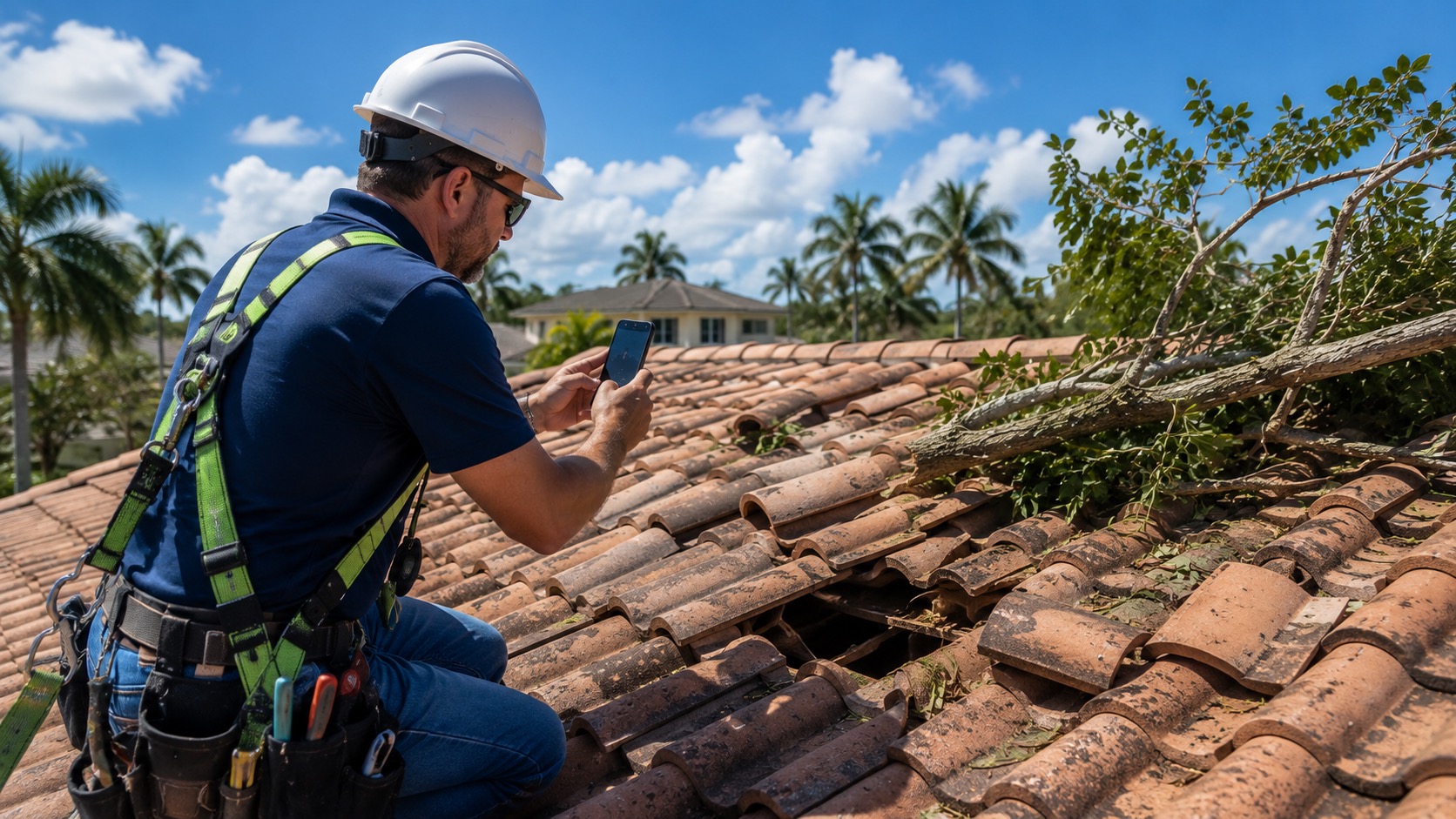
Properly attached tile is designed and tested for South Florida wind pressures. After high winds, the TRI Alliance notes that broken tiles are “typically broken by impact from airborne debris,” which doesn’t by itself mean the tiles were lifted by wind, and that prying a tile up 2 inches is not a code test of whether a roof complies (TRI brief 2021-01). After a storm, document from the ground and have a licensed roofer assess the tile and the underlayment.
What drives the cost?
We don’t publish tile prices here, because they depend on the specific roof. The main factors:
- Tile material, profile and availability
- Attachment method and the number of fasteners or adhesive paddies the calculations require
- Underlayment system and flashings
- Roof complexity: valleys, hips, walls, penetrations, skylights, height and slope
- Deck repairs found after tear-off
- Structural review, if you’re switching to tile
- Permits, inspections and testing (such as the TAS 106 uplift test)
- For lift-and-relay: careful removal, breakage and replacement tiles
Next step
If you’re planning a new tile roof or deciding what to do with an aging one, see our roof replacement service or request a free estimate. Ask for the product approval numbers and the attachment method in writing so you can compare proposals.
Sources
- 2023 Florida Building Code, Building, 8th Edition — Chapter 15 Roof Assemblies and Rooftop Structures (codes.iccsafe.org)
- 2023 Florida Building Code, Residential, 8th Edition — Chapter 44 High-Velocity Hurricane Zones (codes.iccsafe.org)
- 2023 Florida Building Code, Existing Building, 8th Edition — Chapter 7, Section 706 Reroofing (UpCodes) (up.codes)
- FRSA-TRI Florida High Wind Concrete and Clay Tile Installation Manual, 7th Edition (12/31/2023) (eagleroofing.com)
- Miami-Dade NOA 26-0527.03 — Santafe Spanish 'S' Clay Roof Tile (approved 08/13/26, expires 02/01/31) (miamidade.gov)
- Miami-Dade Product Control — 9th Edition FBC (2026) Roofing Underlayment Updates (July 31, 2026) (miamidade.gov)
- Miami-Dade Product Control — NOA search (miamidade.gov)
- Florida Building Commission — Product Approval search (floridabuilding.org)
- TRI Alliance — Frequently Asked Questions (tileroofing.org)
- TRI Alliance Technical Brief #2021-01 — Evaluation of Roofs After High Wind Events (tileroofing.org)
- Eagle Roofing Products — Technical Specifications (eagleroofing.com)