Updated: October 20, 2026
A cool roof stays cooler in the sun because its surface reflects more sunlight and sheds absorbed heat efficiently. In a cooling-dominated climate like Miami’s, that can lower attic temperatures and air-conditioning use. How much depends on your insulation, where your ducts run, and how well the surface stays clean in humid weather.
The three numbers that define a “cool” roof
The U.S. Department of Energy (Consumer Guide to Cool Roofs; Guidelines for Selecting Cool Roofs) defines them as follows:
| Property | What it is | Typical values (DOE) |
|---|---|---|
| Solar reflectance | ”The amount of sunlight that is reflected, expressed as a fraction,” on a 0–1 scale | ”Most dark roof materials reflect 5 to 20% of incoming sunlight, while light-colored roof materials typically reflect 55 to 90%.” |
| Thermal emittance | ”The efficiency with which a surface cools itself by letting go of the heat it has absorbed,” 0–1 | Nearly all nonmetallic surfaces are high, “usually between 0.80 and 0.95.” Bare, shiny metal is low. |
| Solar Reflectance Index (SRI) | One number calculated from the two above | ”A clean black roof could have an SRI of 0, while a clean white roof could have an SRI of 100. Dark roofs usually have an SRI less than 20.” |
Both properties matter. Bare, unpainted metal can reflect a lot of sunlight but hold on to its heat because its emittance is low. Painted metal behaves very differently.
How to read a CRRC rating
The Cool Roof Rating Council (CRRC) is the independent body that lists measured values for roofing products. Its directory reports two sets of values (user guide):
- Initial: measured on a new sample.
- Aged: measured after “three-year weathering in three designated U.S. climates.” “Pending” means the weathering is still under way.
Two things to know:
- A rating is not an endorsement. The CRRC “does not require rated products to meet or exceed a minimum value,” and “any product can be rated … regardless of its radiative performance” (FAQ). A CRRC label only means the numbers were measured. You still need to compare them.
- Use aged values in Miami. Researchers at Lawrence Berkeley National Laboratory explain that soiling comes from “the deposition of atmospheric particulate matter and the growth of microorganisms, each of which absorb sunlight.” Their lab method was calibrated to products exposed “for 3 years in a hot and humid climate (Miami, Florida)” (LBNL, 2014).
You may still see “ENERGY STAR roof” in older brochures. That program is over. The ENERGY STAR specification for roof products “was sunset on June 1, 2022” (ENERGY STAR), and no roofing product can carry the label today.
What Florida research found
Two Florida Solar Energy Center (FSEC) field studies give real local evidence:
- Six identical homes, Fort Myers. The homes had the same floor plans and orientation and R-19 ceiling insulation. The researchers estimated that “the three white reflective roofs would reduce cooling energy consumption by 18-26%,” while “terra cotta tile roofs and white shingles would produce cooling savings of 3-9% and 3-5%.” Measured solar reflectance ranged from 8.2% for a dark gray shingle to 77.3% for a flat white tile. Terra cotta barrel tile measured 34.6% and white painted metal 66.2% (FSEC-CR-1220-00).
- Nine Florida homes retrofitted with reflective roofs. Air-conditioning savings “averaged 19%, ranging from a low of 2% to a high of 43%.” The authors found savings “depend on ceiling insulation level and roof solar reflectance, air duct system location and air conditioner sizing” (FSEC-PF-293-95).
These are results for specific houses, not a promise for yours. They show the direction and the variables. A light, highly reflective surface makes a measurable difference here. A “slightly lighter” color makes a small one.
What works against you in a humid climate
Algae and dirt. DOE warns that “in warm, moist locations, cool roof surfaces can be more susceptible to algae or mold growth than hot roofs,” which can “look bad and reduce the roof’s reflectance.” In the FSEC retrofit study, one white roof “developed a green algae” in its first winter. Its reflectance dropped from 0.71 to 0.59, and the researchers attributed most of the discoloration to blue-green algae (Gloeocapsa magma). DOE adds that most soiling happens “during the first year or two, and then values tend to stabilize.” That is why aged values are the realistic ones.
Not a substitute for insulation. DOE is direct: cool roofs “are never a substitute for using sufficient thermal insulation,” and “a well-insulated roof will benefit less from a cool roof than a poorly insulated roof.” FSEC found the same thing, with “larger reductions associated with poorly insulated roof assemblies.”
Ducts in the attic. If your air-conditioning ducts run through the attic, roof temperature matters more. FSEC lists duct location as one of the variables that set the savings. In its Fort Myers test, the control home’s attic ran 40 °F above outdoor air at the summer peak, while the attics under highly reflective roofs ran no hotter than outdoor air.
Replacing a sound roof just to make it cool. DOE notes “it is rarely economical to replace a mechanically sound roof just to increase its solar reflectance.” The best time to choose reflectance is when the roof is being replaced anyway.
Cool options by roof type
DOE notes that for steep roofs “cool asphalt shingle, clay tile, concrete tile, and metal products are available.” In practice:
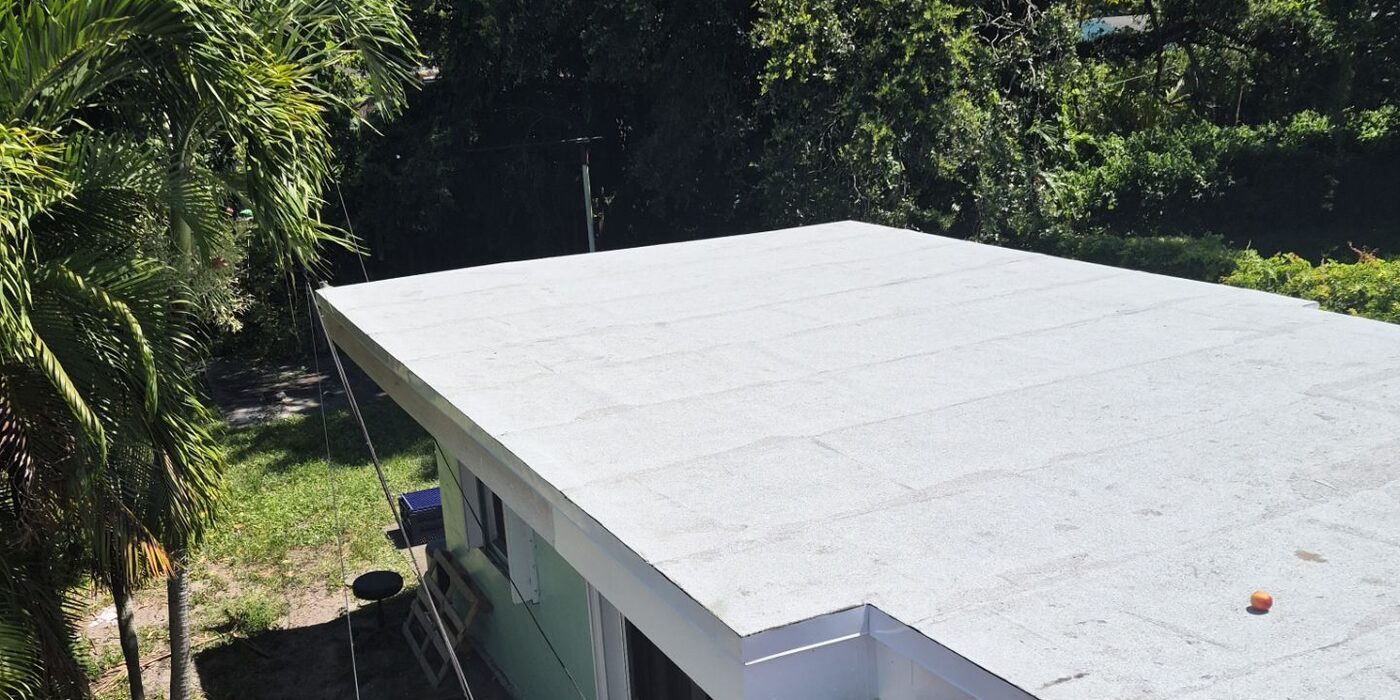
- Low-slope (flat) roofs: white or light single-ply membranes, light granulated cap sheets, and reflective coatings. These are compared in TPO vs. modified bitumen vs. EPDM.
- Metal: a light-colored painted finish combines high reflectance with high emittance. See the metal roofing guide for coating and coastal choices.
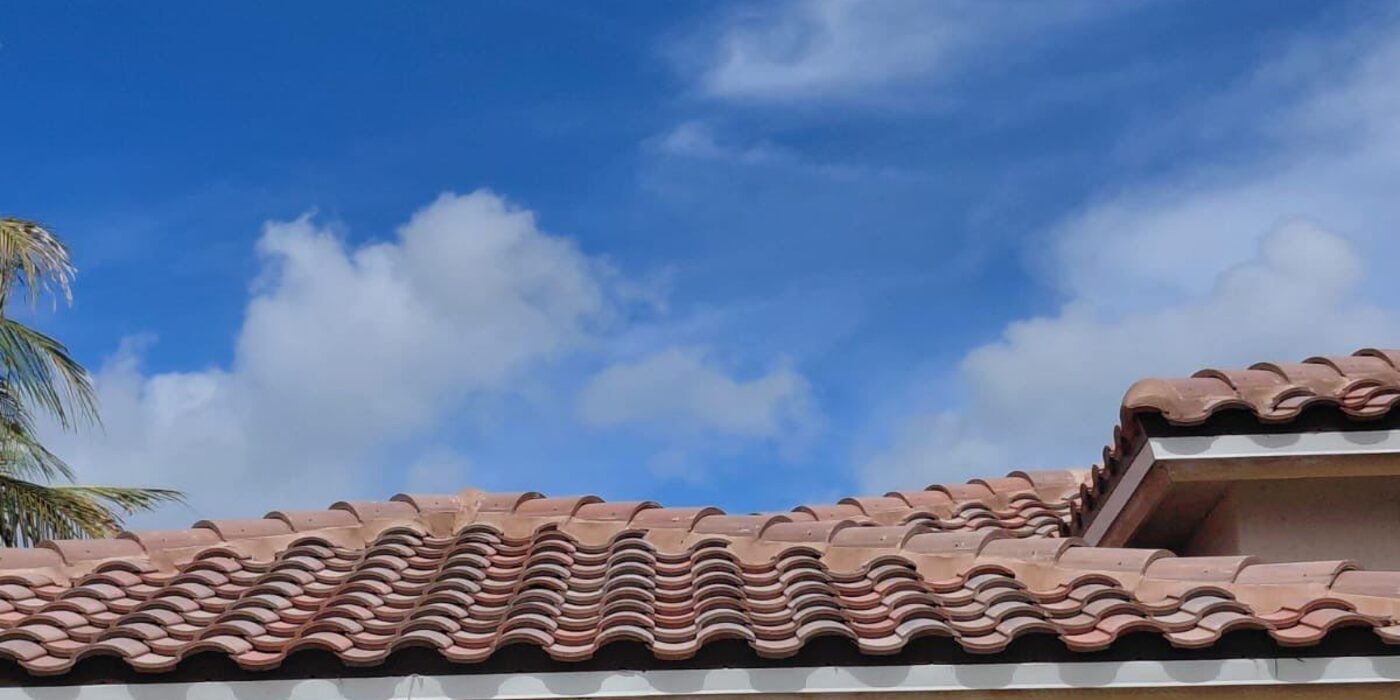
- Tile: color matters a lot. In the FSEC study, white tile reflected more than twice as much sunlight as terra cotta.
- Shingles: “cool” shingles exist, but even white shingles measured only 24% reflectance in the FSEC study.
If your HOA or city reviews roof colors, check that before choosing a color for reflectance alone. For one local example, see roof color approval in Coral Gables.
Does the Florida code require a cool roof?
For a single-family home, no. It is an option, not a minimum. The Florida Building Code, Energy Conservation (8th Edition, 2023) includes “installation criteria for homes claiming the cool roof option” (§R405.7.2) as a credit in the performance compliance path. The Ninth (2026) Edition, effective December 31, 2026, replaces the reflectance standards for that credit and adds a “roof solar reflectance index credit” (§R407.2.1.3) (Florida Building Commission, residential analysis).
Commercial buildings are different. The commercial energy code contains a table of minimum roof reflectance and emittance options (Table C402.3) and an aged-reflectance provision (§C402.3.1). The 2026 edition updates their test-standard references (commercial analysis). Whether and how they apply to a given building is a question for its designer, so we don’t summarize the values here.
Questions to ask before you choose
- What are the product’s three-year aged solar reflectance, thermal emittance and SRI in the CRRC directory?
- How well is the attic or roof deck insulated, and where do the ducts run?
- Does the finish include algae resistance, and what does its warranty say about discoloration?
- Does the color need HOA or city approval?
- Does the product have the wind approval required for your roof in the HVHZ? Reflectance never replaces that.
Next step
The best time to choose a cool roof is when you are replacing the roof anyway. Art’s Roofing & Construction installs tile, metal, shingle and flat roofs in Miami-Dade, Broward and Palm Beach. Read about roof replacement or request a free estimate, and ask us to include reflectance values for the options we price.
Sources
- U.S. DOE — Guidelines for Selecting Cool Roofs (July 2010, v1.2) (energy.gov)
- U.S. DOE — Consumer Guide to Cool Roofs (DOE/EE-2478) (energy.gov)
- Cool Roof Rating Council — Rated Roof Products Directory (coolroofs.org)
- Cool Roof Rating Council — Rated Products Directory User Guide (January 2022) (coolroofs.org)
- Cool Roof Rating Council — Roof Program FAQs (coolroofs.org)
- ENERGY STAR — Roof Products specification (sunset June 1, 2022) (energystar.gov)
- FSEC-CR-1220-00 — Parker, Sonne & Sherwin, Comparative evaluation of roofing systems, Ft. Myers (2002) (fsec.ucf.edu)
- FSEC-PF-293-95 — Parker et al., Measured cooling energy savings from reflective roofing in Florida (fsec.ucf.edu)
- Lawrence Berkeley National Laboratory — Soiling of building envelope surfaces and its effect on solar reflectance, Part II (2014) (eta-publications.lbl.gov)
- Florida Building Commission — Analysis of Changes, 9th Edition (2026) FBC-Energy Conservation, Residential (floridabuilding.org)
- Florida Building Commission — Analysis of Changes, 9th Edition (2026) FBC-Energy Conservation, Commercial (floridabuilding.org)