Updated: October 20, 2026
A metal roof near salt water lasts or fails mostly on three choices: the base metal, the metals it touches, and whether it is installed exactly as its approval describes. The paint finish matters too, but it cannot make up for a mistake in any of those three.
This guide is about metal only. To weigh metal against tile and shingle, start with our tile vs. metal vs. shingle comparison.
How salt air attacks a metal roof
Salt carried on the breeze settles on every surface. In sheltered spots that rain does not rinse, it stays wet and keeps working: under the eaves, at laps, behind debris, and around fasteners. That is why the manufacturers’ warranties below talk about distance from the water, about “repeated spraying of either salt or fresh water,” and about debris that is not removed.
Distance alone is not the full picture. A house a few blocks inland but facing an open bay can see more salt than one farther from the beach behind other buildings. Read the specific warranty’s wording and ask how it applies to your address.
Aluminum or coated steel?
Residential metal roofing in South Florida is usually one of two base metals:
- Aluminum. It does not rust and holds up well in marine air.
- Steel with a metallic coating. Typically aluminum-zinc (sold as Galvalume® or Zincalume®) or zinc (galvanized), then painted.
In the HVHZ, the Florida Building Code sets minimums for both: steel panels “shall be a minimum of G-90 corrosion resistant, and shall be not less than 26 gage,” and aluminum panels at least 0.025 inch thick (FBC-Building 2023, §1518.9, text). Those are floors, not recommendations for a coastal lot.
What the manufacturers say about coastal sites is more telling:
| Manufacturer document | What it says about the coast |
|---|---|
| Englert warranty, Rev. 7 (2022) | “Within one half mile from the seacoast, salt water, or brackish water, Englert does not offer any warranty for any period of time on prepainted Galvalume®.” Prepainted aluminum stays warrantable near the water, with an annual fresh-water rinse. |
| PAC-CLAD coastal aluminum warranty | Within 1,500 feet of salt or brackish water, the owner must rinse with fresh water twice a year. Installations under “constant or direct spraying” are excluded. Its Tite-Loc product page states: “For coastal applications, aluminum panels along with stainless steel clips must be used for finish warranty.” |
| Drexel Metals Galvalume warranty (2025) | Excludes salt-water marine atmospheres and sets minimum distances: 2,800 feet from surf coastline, 1,200 feet from a large bay, 600 feet from marshes and canals. |
Each manufacturer sets its own distances and conditions, and they differ. If you live near the ocean, Biscayne Bay, or a salt-water canal, ask for the actual warranty document for the panel being quoted and check the coastal clause before you sign.
Fasteners, flashings and galvanic corrosion
When two different metals touch in the presence of moisture (and salt water is a very good conductor), the less noble one corrodes faster. The Metal Construction Association gives the classic case: “a galvanized (zinc-coated) nail in an aluminum roof … the zinc coating will deplete quickly.” Its bulletin also states:
- Copper is the main enemy. “Copper has a very severe corrosive effect on steel, aluminum, and zinc.” That includes runoff: water draining from a copper pipe, copper flashing or HVAC line onto Galvalume can corrode it without the metals touching.
- Treated lumber. “Preservative-treated lumber and like products should not be used on metal roofs.”
- Stainless grade near the coast. “In marine or severe industrial applications … 316L is generally a minimum requirement. The same applies for stainless steel fasteners.”
- Alkaline materials. Galvalume has “a severe sensitivity to strong alkalis,” such as wet mortar, concrete and stucco. On a CBS house, that matters where panels and flashings meet stucco walls.
A steel-coil producer, Steelscape, adds that in corrosive environments “stainless steel components should be used in conjunction with profiles fabricated out of aluminum,” not with coated steel panels. Englert’s warranty calls for fasteners “electrically insulated from the panel surface (e.g., with elastomeric grommets).”
The practical rule: the panel, clips, screws, edge metal, flashings and any nearby pipes or equipment should be specified together, as one system. If anything on the roof is copper, say so before the job is quoted.
What “PVDF,” “Kynar 500®” and “Hylar 5000®” actually mean
Quotes often say “Kynar paint,” but that is not quite right.
- PVDF (polyvinylidene fluoride) is a resin, one ingredient of the coating. As AkzoNobel puts it, “PVDF is a component of the coating, not the coating itself.”
- Kynar 500® (Arkema) and Hylar 5000® (originally Solvay) are brand names of PVDF resin. They are not paints.
- The finish itself is made by a coil coater, under its own product name. Examples include Sherwin-Williams Fluropon, PPG Duranar and AkzoNobel Trinar.
- The 70% figure. Arkema licenses Kynar 500® only to coaters that use “nothing less than 70% Kynar 500® PVDF resin” in the binder (Arkema). AkzoNobel advises specifying “a 70% PVDF coating system” that meets AAMA 2605 for aluminum or AAMA 621 for steel.
So the useful question is: which coating, what PVDF content, which AAMA specification, and what does its finish warranty say about the coast? A PVDF finish resists fading and chalking. It does not stop a cut edge, a scratch or a wrong fastener from corroding.
Standing seam vs. 5V-crimp
| Standing seam | 5V-crimp | |
|---|---|---|
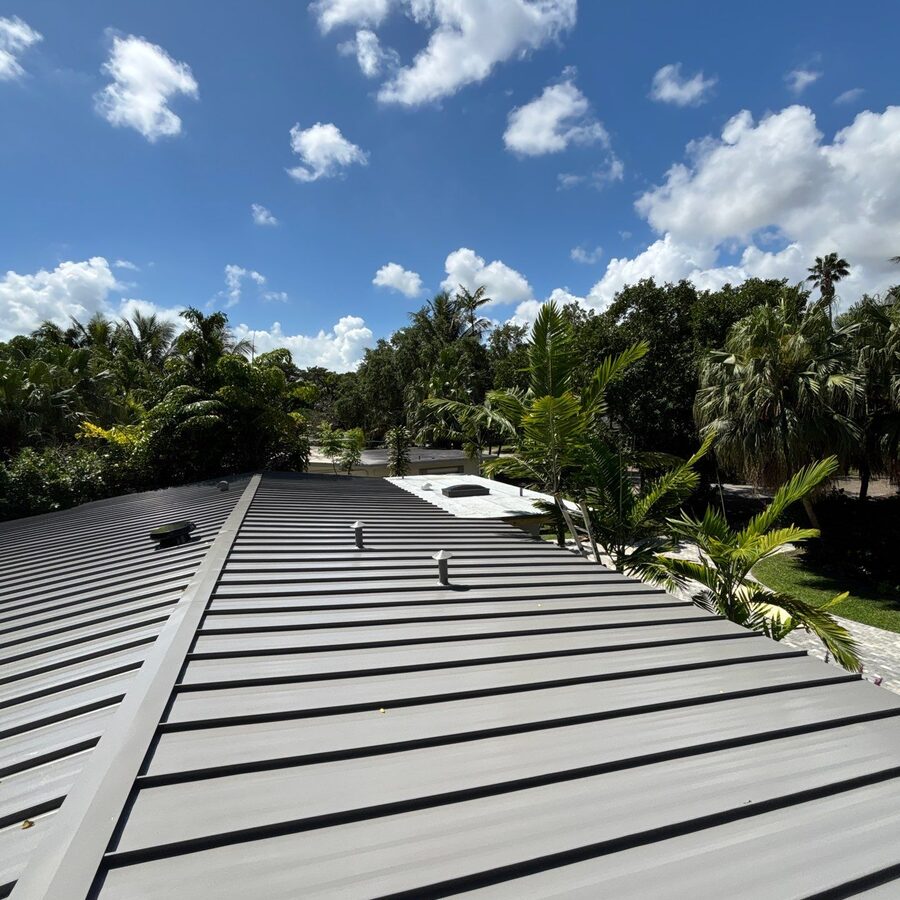
| How it attaches | Concealed clips inside raised seams. See standing seam. | Screws through the panel face, so the fasteners are exposed. See 5V-crimp. |
| Holes in the weather surface | None in the field of the panel | One at every fastener, sealed with a washer |
| Thermal movement | Clips let panels expand and contract | The fasteners take the movement |
| What to maintain | Seams, trim and penetrations | Every fastener washer, plus trim and penetrations |
| Look | Tall, clean vertical ribs | Low “V” ribs; a traditional Florida look |
The Metal Construction Association describes clip-attached standing seam systems as “premium technologies over face-fastened panel designs from a weathering and durability standpoint at a modest increase in cost,” because clips eliminate “fastener penetration of the weathering surfaces.” McElroy Metal describes 5V as a “traditional exposed-fastener metal roofing panel … recognized for its classic V-rib design and coastal appeal” (McElroy).
Neither profile is inherently “hurricane-proof.” Both can be approved for the HVHZ, and their wind performance comes from the specific approved system.
Approvals: why wind ratings belong to a system, not a material
In Miami-Dade and Broward (the High-Velocity Hurricane Zone), the code requires that “all roofing components, roofing systems and roofing assemblies shall have a valid and current product approval” (FBC-Building 2023, §1512.2.1). It also says “the entire application method of all metal panel/shingle systems shall be detailed in the product approval” (§1518.9.2). If an approval and the manufacturer’s literature conflict, “the product approval shall prevail.”
An approval can be a Miami-Dade Notice of Acceptance (NOA), issued by the county’s Product Control section, or a Florida Product Approval under Rule 61G20-3 that covers the HVHZ.
Here is what that means in practice, using one example metal-panel NOA (a 24-gauge steel standing seam over plywood):
- It applies only to a wood deck of a stated plywood thickness, at a slope of 2:12 or more, with named clips, screws and sealant.
- Its design-pressure ratings differ by roof zone. The perimeter and corners need clips at half the field spacing to reach their higher rating.
- It says “extrapolation shall not be allowed.”
- It expires on a stated date, and a copy must be available on the job site.
The same panel on a different deck, at a lower slope or with wider clip spacing is not covered by that approval. When someone quotes a wind speed for a metal roof, ask for the NOA or FL number and check that it covers your deck, slope and the pressures your engineer or permit requires.
These rules are from the Florida Building Code, 8th Edition (2023), in force since December 31, 2023. The Ninth (2026) Edition is scheduled to take effect on December 31, 2026 (Florida Building Commission).
Maintenance that actually helps
Do none of this from the roof yourself. Metal is slippery, especially when wet. A garden hose from the ground, and a roofer for anything up top.
- Rinse with fresh water. This is a warranty condition for several manufacturers near the coast: twice a year for PAC-CLAD within 1,500 feet, and annually for Englert and Drexel. Rinsing matters most in the sheltered areas rain does not reach. The zinc industry’s guidance suggests washing soffits and areas under eaves about every six months (GalvInfoNote 6.4).
- Do not scrub abrasively. PAC-CLAD’s warranty says “no abrasive or chemical cleaners should be used on the coating at any time.”
- Clear debris. Leaves and dirt hold moisture and salt against the metal. GalvInfo notes they “prevent the quick drying that is vital for a long-life roof.” Several warranties exclude damage from debris that was not removed.
- Inspect fasteners and seals. This applies especially to exposed-fastener (5V) roofs, and after strong winds.
- Keep gutters clear.
What drives the cost of a metal roof
We are not publishing prices here. These are the factors that move a metal quote:
- Base metal: aluminum or coated steel, and its gauge or thickness.
- Profile: standing seam (concealed clips, more fabrication) or 5V-crimp (exposed fasteners).
- Coating system: PVDF or another finish, and its warranty terms.
- The approved system: clip spacing, fastener type and deck requirements in the NOA, especially at perimeters and corners.
- Roof shape: hips, valleys, penetrations, skylights and wall transitions each add trim and labor.
- Deck condition: sheathing replaced or re-nailed after tear-off.
- Underlayment and secondary water barrier required under the panel.
- Coastal upgrades: stainless or 316 fasteners, isolation details, aluminum trim.
- Permit and inspections in your jurisdiction.
To get a feel for quantities (roof area, squares), try the roof cost calculator.
Next step
If you are considering metal, the first step is an inspection and a quote that names the panel, coating, fasteners and approval number. That lets you compare bids line by line. Art’s Roofing & Construction installs metal roofing as part of roof replacement in Miami-Dade, Broward and Palm Beach. Request a free estimate.
Sources
- Florida Building Commission — home page (8th Edition (2023) effective date) (floridabuilding.org)
- Florida Building Commission — 9th Edition (2026) FBC Code Update Development Tasks (August 2026) (floridabuilding.org)
- Florida Building Code, Building, 8th Edition (2023), Chapter 15 Roof Assemblies (UpCodes text) (up.codes)
- Miami-Dade County — Product Control (Product Approval) (miamidade.gov)
- Miami-Dade NOA No. 24-0919.06 — 1.5" Standing Seam 24 ga. Steel Panel over Plywood (example) (miamidade.gov)
- Florida Administrative Code, Chapter 61G20-3 Product Approval (flrules.org)
- Metal Construction Association — Dissimilar Metal Corrosion in Roofing Installations (Technical Bulletin, 2022) (metalconstruction.org)
- Metal Construction Association — Standing Seam Roof Clips Best Practices Guide (metalconstruction.org)
- Steelscape — Technical Bulletin SPS113 Dissimilar Metals/Galvanic Corrosion (2024) (steelscape.com)
- Englert — Limited Exterior Building Product Finish/Base Metal Warranty (Rev. 7, 5/1/2022) (englertinc.com)
- PAC-CLAD — 30-Year Limited Warranty for Aluminum Products in a Coastal Environment (pac-clad.com)
- PAC-CLAD — Tite-Loc panels product page (pac-clad.com)
- Drexel Metals — 25-Year DREXLUME Warranty (revised January 2025) (drexmet.com)
- Arkema — Kynar 500® coatings: consistency through licensing (kynar500.arkema.com)
- AkzoNobel — Understanding PVDF (fact sheet) (metalcoatings.brand.akzonobel.com)
- McElroy Metal — 5V exposed-fastener panel (mcelroymetal.com)
- GalvInfoNote 6.4 — Successfully Maintaining Structures Clad With Prepainted Metallic-Coated Steel Sheet (2017) (galvinfo.com)