
Updated: October 20, 2026
Florida law now asks condominium associations two different questions about their buildings. The milestone inspection asks whether the structure is safe. The structural integrity reserve study (SIRS) asks what will need replacing and how the association will pay for it. The roof matters in both, and it is the first item the SIRS must cover.
Not legal advice. This is a plain-language summary of the statute text as published on October 20, 2026. Deadlines, exemptions and funding rules have changed several times since 2022 and can turn on facts specific to your association. Confirm how they apply to your building with your association’s attorney and the engineer or architect you retain.
The two requirements at a glance
| Milestone inspection | Structural integrity reserve study (SIRS) | |
|---|---|---|
| Law | s. 553.899, F.S. | s. 718.112(2)(g), F.S. for condos; s. 719.106 for co-ops |
| Buildings | Condo or co-op buildings “three habitable stories or more in height” | Each condo building “three habitable stories or higher” |
| Purpose | Structural safety: load-bearing elements and primary structural systems | Reserve planning: remaining life, replacement cost and a funding plan for listed components |
| Who performs it | Florida-licensed architect or engineer | Licensed engineer or architect, or a CAI-certified reserve specialist or APRA professional reserve analyst (“performed or verified by”) |
| When | By Dec. 31 of the year the building turns 30 (from the certificate of occupancy), then every 10 years. A local agency may require it at 25 years based on local circumstances, including proximity to salt water | At least every 10 years |
| Roof | Not named, but phase one is a visual examination of the building’s major structural components | Listed first: “a. Roof.” |
Small residential buildings are exempt from both: single-family through four-family dwellings with three or fewer habitable stories above ground.
The milestone inspection and your roof
The milestone inspection is “not a code-compliance inspection.” It is a structural inspection by a licensed architect or engineer of the building’s load-bearing elements and primary structural members and systems (s. 553.899(2)(a)).
- Phase one is “a visual examination of habitable and nonhabitable areas of a building, including the major structural components,” with a qualitative assessment. If the professional finds no signs of substantial structural deterioration, phase two is not required.
- Phase two follows only if deterioration is found. It may involve destructive or nondestructive testing.
- Timelines: the association must notify unit owners within 14 days of receiving the local agency’s notice. Phase one is due within 180 days of that notice. The association must send owners a summary within 45 days of receiving the report. Local ordinances must require repairs for substantial structural deterioration to be commenced “within 365 days” after the phase two report is received.
What this means for the roof: a roof leak is not, by itself, a structural finding. The statute’s definition of “substantial structural deterioration” excludes “signs of leakage” and similar surface conditions “unless the licensed engineer or architect… determines that such surface imperfections are a sign of substantial structural deterioration.” In practice, a long-term leak that has reached the roof deck, the structure or embedded steel is the kind of condition an inspector will look at closely. A dry, well-drained roof makes the inspection simpler.
Local programs still apply
Some counties run their own recertification programs alongside the state law. Miami-Dade’s program, for example, requires recertification at 30 years and every 10 years after. Coastal condo and co-op buildings of three or more stories, built in 1998 or later and within three miles of the coastline, are due when the building reaches 25 years (Miami-Dade recertification page). Ask your building department how its program and the state milestone inspection fit together for your building.
The SIRS and your roof
The SIRS must cover, at minimum (s. 718.112(2)(g)1.):
- Roof
- Structure, including load-bearing walls and primary structural members and systems
- Fireproofing and fire protection systems
- Plumbing
- Electrical systems
- Waterproofing and exterior painting
- Windows and exterior doors
- Any other item over $25,000 (or the inflation-adjusted amount) whose failure would negatively affect the items above
For each item, the study must state its estimated remaining useful life and estimated replacement cost or deferred maintenance expense. It must also provide a reserve funding plan that reaches those costs by the end of the item’s useful life. Items with a remaining useful life of more than 25 years may be left out of replacement reserves. Few roofs fall in that group.
Key points for boards, from the current text:
- Deadline. Unit-owner-controlled associations that existed on or before July 1, 2022 had to complete their first SIRS by December 31, 2025. An association required to complete a milestone inspection by December 31, 2026 may do both at the same time, but “in no event may the structural integrity reserve study be completed after December 31, 2026.”
- The visual inspection. The SIRS “is based on a visual inspection of the condominium property.” A milestone inspection (or similar local inspection) done within the past 5 years can replace the visual inspection part, if it meets the paragraph’s requirements.
- Reserves can’t be waived. For budgets adopted on or after December 31, 2024, associations required to have a SIRS cannot vote to provide no reserves or reduced reserves for the SIRS items. Separately, condo reserves must include roof replacement, building painting and pavement resurfacing regardless of cost (s. 718.112(2)(f)).
- Flexibility after a milestone inspection. An association may delay a required SIRS for up to two budget years after a milestone inspection, to put money toward the repairs. For budgets adopted through December 31, 2028, owners holding a majority of the total voting interests may approve pausing or reducing reserve contributions for up to two consecutive annual budgets to fund milestone repairs. A SIRS must then be done before contributions resume. Lines of credit and loans are also addressed. The details and exclusions are your attorney’s territory.
- Reporting. Owners must receive a copy of the SIRS, or notice that it is available, within 45 days. A statement of completion goes to the Division of Condominiums within 45 days.
- Conflicts of interest. A contractor or design professional who bids to perform a SIRS (or a milestone inspection) must disclose in writing any intent to bid on the resulting repair work. Contractors bidding on recommended work must disclose any interest in, or family relationship with, the firm that did the study. Without that disclosure, the association may terminate the contract.
Cooperatives have a parallel SIRS requirement in s. 719.106, and it also lists “Roof” first. The milestone inspection law covers co-op buildings too.
How the law got here
The program started with SB 4-D in 2022 (ch. 2022-269, effective May 26, 2022). It was amended by SB 154 in 2023 (ch. 2023-203), HB 1021 in 2024 (ch. 2024-244, effective July 1, 2024) and HB 913 in 2025 (ch. 2025-175, effective July 1, 2025 except as otherwise provided). The 2026 statute text also lists ch. 2026-14 in its history. If you are reading an article written before mid-2025, its deadlines and thresholds may be out of date.
What boards should prepare on the roof
Whoever performs the SIRS, and any roofer you ask to price the work, will move faster and estimate more accurately with:
- Roof records: permit numbers and dates, the product approval (NOA or FL number) used, original specs and drawings, and as-built details.
- Warranty documents: manufacturer and workmanship warranties, their terms, exclusions and any transfer or notice requirements.
- History: leak logs by location and date, repair invoices, past inspection reports, moisture surveys and insurance claims.
- Maintenance records: drain and scupper cleaning, and service on roof-mounted equipment.
- Access and safety: roof hatch keys, tie-off points, and a contact for rooftop equipment vendors.
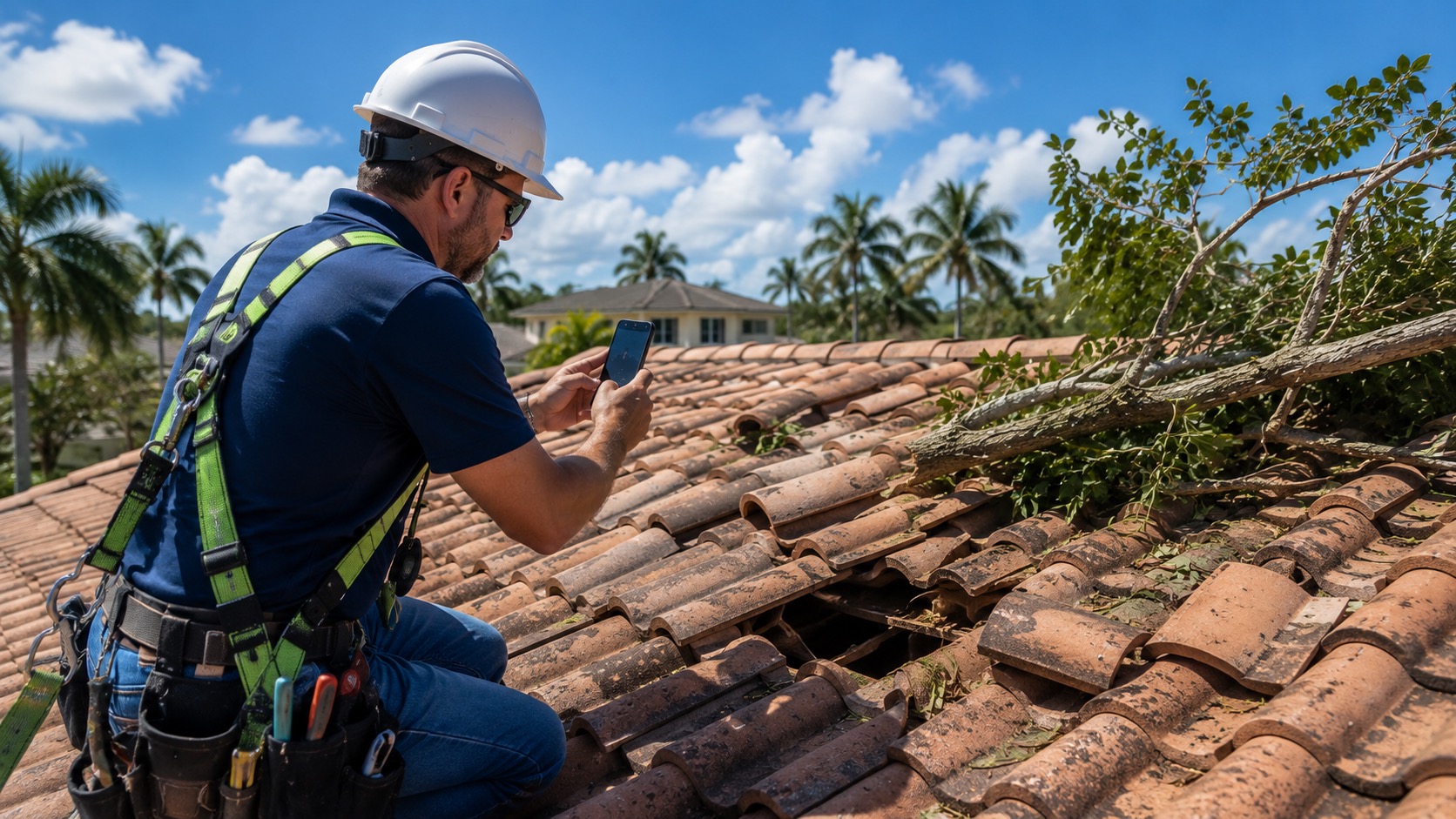
A roofing contractor is not on the statute’s list of who may perform or verify a SIRS. A condition assessment and replacement estimate from a roofer can still give the engineer, architect or reserve specialist better inputs, subject to the disclosure rules above. See what a roof inspection covers.
How a roof replacement fits the plan
The SIRS says roughly when the roof will need replacing and what to reserve. The project itself is ordinary permitted roofing work:
- Design and approvals. In Miami-Dade and Broward (HVHZ), “all roof assemblies, roof coverings and roof systems shall have product approval” (FBC §1515.1). The assembly has to suit your deck and the calculated wind pressures. See TPO vs modified bitumen vs EPDM.
- Phasing. Large roofs are often replaced section by section. In the HVHZ, no more than 25 percent of a roof area or roof section may be “repaired, replaced or recovered in any 12-month period” unless the whole roof or section is redone (FBC §1521.4, 8th Edition). Define the sections in the design so that each phase is a complete section.
- Drainage. A re-roof is the moment to fix ponding water with tapered insulation, crickets or added drains. Doing it in the same project avoids paying twice.
- Permits and inspections. The permit is pulled by the licensed contractor and inspected in stages. Timing depends on the jurisdiction. See roof permits in Miami-Dade, Broward and Palm Beach.
- Owners and residents. Plan notices for noise, crane or hoist days, parking, and work around rooftop equipment.
Next step
Gather the roof records above, then ask for a written roof condition assessment and replacement scope that your engineer or reserve professional can use. Art’s Roofing & Construction (Florida Certified Roofing Contractor CCC1333598, Certified General Contractor CGC1541858) installs flat and low-slope roof systems on buildings in Miami-Dade, Broward and Palm Beach, and NDL manufacturer warranties are available on qualifying systems. See our commercial roofing service or contact us.
Sources
- Florida Statutes (2026) s. 553.899 — Mandatory structural inspections for condominium and cooperative buildings (flsenate.gov)
- Florida Statutes (2026) s. 718.112 — Bylaws (structural integrity reserve study, reserves) (flsenate.gov)
- Florida Statutes (2026) s. 719.106 — Bylaws; cooperative ownership (flsenate.gov)
- Florida Senate — SB 4-D (2022D), Building Safety, ch. 2022-269 (flsenate.gov)
- Florida Senate — CS/CS/SB 154 (2023), Condominium and Cooperative Associations, ch. 2023-203 (flsenate.gov)
- Florida Senate — CS/CS/CS/HB 1021 (2024), Community Associations, ch. 2024-244 (flsenate.gov)
- Florida Senate — CS/CS/HB 913 (2025), Condominium and Cooperative Associations, ch. 2025-175 (flsenate.gov)
- Miami-Dade County — Building Recertification (miamidade.gov)
- 2023 Florida Building Code, Building, 8th Edition — Chapter 15 Roof Assemblies and Rooftop Structures (UpCodes) (up.codes)