Updated: November 15, 2026
A flat or low-slope roof in South Florida has to handle strong sun, heavy afternoon rain and hurricane uplift on the same surface. When one fails early, the cause is usually at the edges, around rooftop equipment or where water sits, not in the open field of the membrane. This page is the overview for building owners, managers and associations. The membrane comparison and the drainage details have their own guides, linked below.
Where do flat roofs fail first?
FEMA’s hurricane handbook for low-slope roofs says these roofs “often fail at the edges” in high winds, from “lifting and peeling metal edge flashings, copings, or fascia covers.” Gutters lifted by wind can pull the edge flashing with them and start “a progressive peeling of the roof membrane.” Poorly anchored rooftop units can be knocked loose and tear the membrane as they move, and HVAC access panels blown off in a storm become debris that punctures it (FEMA P-2181, 3.3.2).
Day to day, standing water is the other common cause. NRCA defines ponding as water at low spots “that remains more than 48 hours after precipitation” (NRCA). Water that sits finds weak seams and flashings. Foot traffic to service equipment wears paths into an unprotected membrane. When we look at a leaking flat roof, we start at the perimeter, the curbs, the drains and the walkways.
Repair, recover or tear off?
This is the first decision on any aging flat roof, and the condition under the membrane decides it. In Miami-Dade and Broward (the High-Velocity Hurricane Zone, HVHZ), the code does not allow a new roof system over an existing roof where the sheathing is not fastened to code, will not hold fasteners, or is “water soaked or deteriorated.” Deteriorated sheathing has to be replaced (FBC 1521.5). One additional roof system may go over an original roof assembly, as long as the existing assembly meets the reroofing section (1521.9). Insulation found to be wet is removed from the job at the building official’s direction (1520.5.1) (FBC Chapter 15).
| Option | When it fits | What to check first |
|---|---|---|
| Repair | Damage is local: a seam, a flashing, a curb, a drain | That the repair does not create new ponding (FBC 1521.3) |
| Recover | Original single assembly, dry insulation, sound deck | Moisture readings, deck fastening, no prior recover |
| Tear-off and replace | Wet insulation across large areas, a prior recover, deck damage | Deck repairs, drainage redesign, tapered insulation |
A recover that buries wet insulation only traps the problem. Ask for moisture readings marked on a roof plan before you accept a recover proposal.
TPO or modified bitumen?
Both are common on South Florida commercial roofs, and both can perform when installed as the exact approved assembly. TPO is a heat-welded single-ply sheet, typically white. Modified bitumen is laid in two or more plies, and its surfacing decides how reflective it is. FEMA’s low-slope guidance also notes that a modified bitumen membrane “is more resistant to puncture than other membrane systems,” which matters on roofs with heavy service traffic or exposure to wind-borne debris (FEMA P-2181, 3.3.2).
The bigger point is that an approval covers a whole assembly on a specific deck type. A GAF TPO approval, for example, is written for systems “over Steel Decks” and lists the membrane, insulation, fasteners and seam widths that must be used together (NOA 23-0616.04). Our TPO vs. modified bitumen vs. EPDM guide compares the membranes property by property and shows how much the deck changes the rated pressure.
Does my roof drain well enough?
Slope and drains matter as much as the membrane. In the HVHZ, new construction needs a minimum deck slope of 1/4 inch per foot (FBC 1515.2.2.1), and unless the roof sheds water over its edges, “roof drains shall be installed at each low point” (1514.4). A roof that ponds before a re-roof will pond after it, unless the new design adds tapered insulation, crickets or drains.
Tapered insulation costs more up front, but it targets the most common cause of early flat-roof failure in this climate. Ask the contractor to mark the ponded areas on a plan and show how the new design moves water to a drain or scupper. The ponding water guide covers overflow scuppers, drain sizing and when an engineer should look at a sagging deck.
What should the edges and rooftop equipment get?
Edge metal is a tested part of the roof, not trim. The Florida Building Code requires metal edge systems on built-up, modified bitumen and single-ply roofs to be tested under ANSI/SPRI ES-1 (test methods RE-1, RE-2 and RE-3) or RAS 111, and designed for the wind loads of Chapter 16 (FBC 1504.5). FEMA adds practical steps: attach copings and fascia with screws and washers instead of relying on cleats alone, and add a peel-stop bar near the edge so the membrane holds if the metal fails.
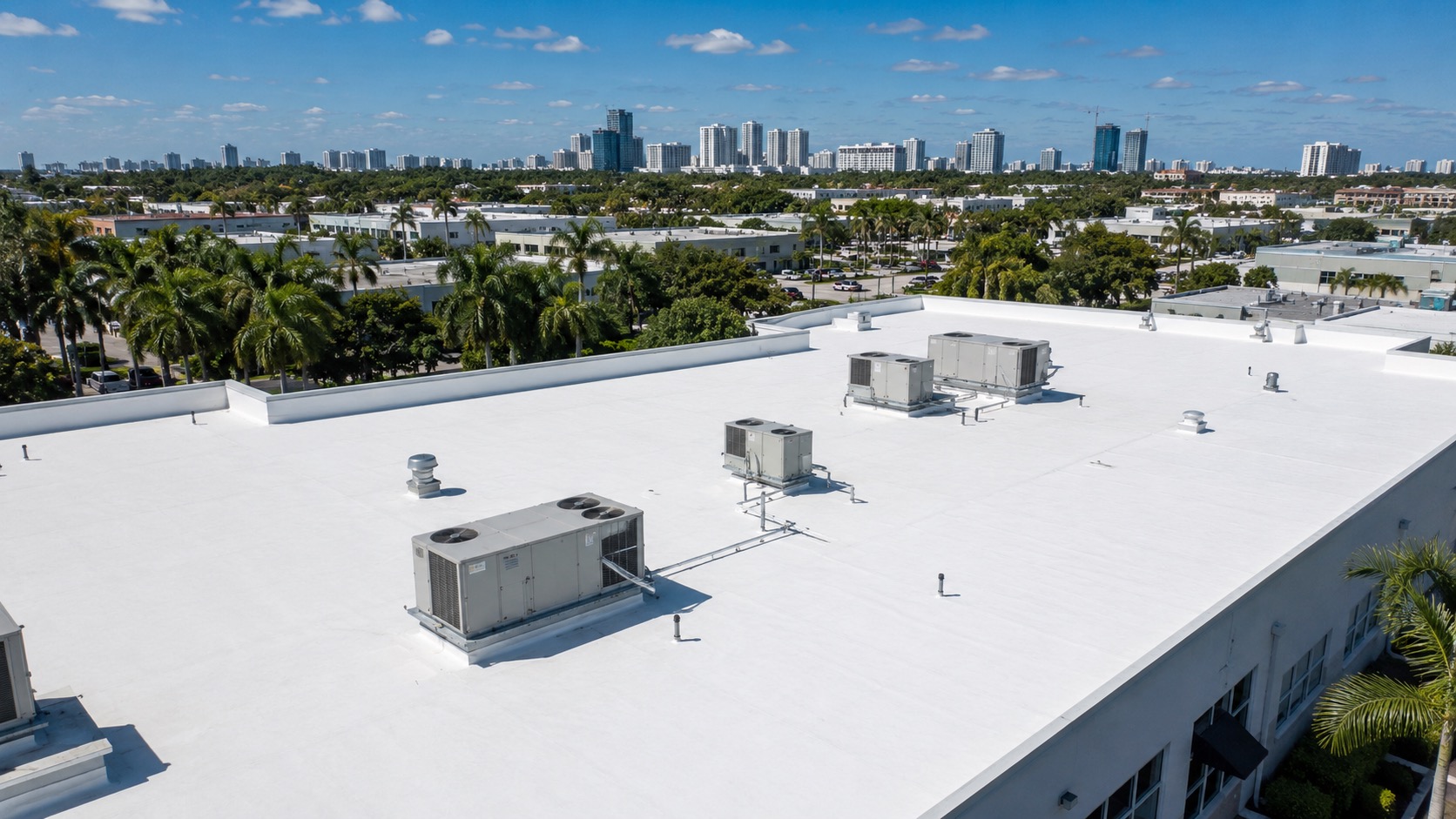
For equipment, FEMA recommends solid curbs or pedestals so units are bolted down without cutting through the membrane, tie-downs designed for the region’s wind, and locking hardware on access panels. Gutters on low-slope roofs should be designed to ANSI/SPRI GD-1 (FEMA P-2181, 3.3.2). A proposal that prices the membrane but says nothing about edges, curbs and gutters is missing the parts that fail first.
Does a white roof pay off here?
It helps, and it helps most in hot climates. The Department of Energy notes that TPO and PVC membranes “are typically white” and that cool roofs save the most cooling energy in hot climates. It also notes that reflectance drops as roofs get dirty, mostly in the first year or two, and that cleaning can restore up to 90% of the original value, though in DOE’s view the energy savings alone don’t justify the cost of cleaning (DOE). For modified bitumen, “the surfacing material determines the radiative properties” (CRRC).
Use the Cool Roof Rating Council directory to compare products, and look at the three-year weathered values, not the initial ones. Be wary of an “ENERGY STAR roof” claim: the ENERGY STAR roof products specification “was sunset on June 1, 2022” (ENERGY STAR). More in our cool roof guide.
What if the building is a condominium?
Florida condominium buildings three habitable stories or higher must have a structural integrity reserve study, and the roof is the first item on its list, along with waterproofing and windows and exterior doors (s. 718.112(2)(g), Florida Statutes). A roof survey with moisture readings and a remaining-life estimate gives the board numbers it can use in that study. Our condo milestone and SIRS guide explains the timeline.
What drives the budget?
We don’t publish a flat-roof price, because the cost is set by conditions you can only see on site:
- Area, in roofing squares of 100 sq ft.
- Tear-off or recover, and how much wet insulation and damaged deck has to come out.
- Tapered insulation or crickets to fix drainage.
- Perimeter: length of edge metal, copings and parapet flashing.
- Penetrations and equipment: curbs, drains, vents and units that must be lifted or re-set.
- Phasing and access around tenants and business hours.
How to compare bids
Ask each bidder for the same things: the NOA or Florida Product Approval number and the system number inside it, the deck type it is written for, a moisture survey, the edge metal standard, a drainage plan and a written scope for every curb and drain. Bids that differ on those points are not the same roof at different prices. After the job, FEMA recommends inspecting low-slope roofs at least twice a year and after high-wind events.
Next step
Before you price a re-roof, get the roof surveyed: moisture readings, photos of every edge, curb and drain, and a written recommendation to repair, recover or replace. Art’s Roofing & Construction is a GAF Certified Commercial Contractor working in Miami-Dade, Broward and Palm Beach. See our flat roofing and commercial roofing services or request a roof assessment.
Sources
- FEMA P-2181 Fact Sheet 3.3.2 — Roof Systems: Low-Slope Roofs (March 2022) (fema.gov)
- Florida Building Code, Building, 8th Edition (2023), Chapter 15 Roof Assemblies and Rooftop Structures (Sections 1504.5, 1514, 1515, 1520, 1521) (codes.iccsafe.org)
- NRCA Roofing Glossary — Ponding (nrca.net)
- Miami-Dade NOA 23-0616.04 — GAF EverGuard TPO Single Ply Roofing Systems over Steel Decks (miamidade.gov)
- U.S. DOE — Guidelines for Selecting Cool Roofs (July 2010, v1.2) (energy.gov)
- Cool Roof Rating Council — Low-Sloped Roofing Product Types (coolroofs.org)
- ENERGY STAR — Roof Products specification (sunset June 1, 2022) (energystar.gov)
- Florida Statutes (2026) s. 718.112 — Bylaws (structural integrity reserve study) (flsenate.gov)