Updated: August 9, 2026
Your roof is the single most important system protecting your home from a hurricane — and Miami-Dade has some of the strictest roofing rules in the country for exactly that reason. Most “how to pick a roofer” advice stops at “get three quotes.” This guide goes further: every check below is one you can perform yourself, in public records, before you sign anything.
1. Verify the license yourself — don’t take a photo of one
In Florida, roofing work requires a state-certified or registered roofing contractor’s license. Ask for the license number and look it up directly on the Florida Department of Business & Professional Regulation portal at myfloridalicense.com, where you can search by name, license number, city, or county.
Three things to check once you find the record:
- The prefix tells you what they can legally do.
CCCis a Certified Roofing Contractor andRCis a Registered Roofing Contractor — both can roof.CGC(general) andCBC(building) cover broader construction work. - The status must say active, not expired, delinquent, or null.
- The qualifier’s name should connect to the company you’re hiring. A common trick is borrowing someone else’s license. If the name on the license has nothing to do with the business quoting you, ask why.
“My buddy does roofs” is not a license. Neither is a laminated card in a truck.
2. Confirm both kinds of insurance
A legitimate roofer carries general liability and workers’ compensation. These are not interchangeable. Liability covers damage to your property; workers’ comp covers injuries to the crew. Without workers’ comp, a fall on your roof can become your financial problem.
Ask for the certificate of insurance and check the expiration dates. Better: ask the contractor to have their insurance agent email the certificate to you directly. A certificate that comes straight from the agent can’t have been edited in between.
3. Demand NOA products — and look them up
Miami-Dade and Broward sit in a High-Velocity Hurricane Zone (HVHZ), the strictest wind-design region in the United States. Materials installed here must carry a Notice of Acceptance (NOA) proving they’ve been tested and approved for our wind speeds and impact requirements.
Here’s the part almost nobody tells homeowners: you can verify the NOA yourself. Miami-Dade publishes its Product Control Search, where anyone can look up approved products, certificates, and listings by file number, manufacturer, product category, or design pressure.
Ask your contractor for the specific NOA file numbers for the tile, shingle, underlayment, and fasteners they plan to use — then search them. A contractor who can talk fluently about NOA numbers, secondary water barriers, and ring-shank nailing patterns is ready for a Miami roof. One who gets vague when you ask for a file number is not.
4. Know the 25% rule before anyone quotes you
This is where homeowners get upsold most often.
Florida Building Code section 706.1.1 — the “25% rule” — historically said that if more than 25% of a roof was repaired or replaced within any 12-month period, the entire roof had to be brought up to current code. Contractors have used this for years to turn a repair into a full replacement.
But Senate Bill 4-D changed that in May 2022. Under the updated Florida Statute 553.844(5), if your existing roof was built, repaired, or replaced in compliance with the 2007 Florida Building Code (effective March 1, 2009) or any later edition, only the repaired or replaced portion has to meet current code. The 25% threshold no longer forces a full replacement.
So the practical question is: when was your roof permitted? If it went on after March 2009, and a contractor tells you code requires a complete tear-off for a partial-damage repair, ask them to point to the specific code section. Roofs permitted before that date generally do still trigger the full-replacement requirement.
This one check can be the difference between a repair and a five-figure replacement.
5. The permit goes in their name — and it’s public
The roofer should pull the permit under their license and schedule the required inspections. If a contractor asks you to pull an owner-builder permit, walk away — that shifts all liability, code compliance, and inspection responsibility onto you, and it usually means their license can’t support the job.
Permits are public record. You can look up a contractor’s permit history through your municipal or county building department to see whether they actually pull permits and whether their inspections pass.
6. Get both warranties in writing — they are different things
Two separate warranties should appear in your contract:
- The manufacturer’s material warranty, which covers the product itself. Extended versions (the long ones contractors advertise) are usually only available through installers the manufacturer has certified — which is why certification status matters beyond marketing.
- The contractor’s workmanship warranty, which covers the installation. This is the one that matters when a leak appears at a flashing detail, and it’s only as good as the company standing behind it.
A real contract also spells out scope, materials by brand and product name, timeline, and payment schedule. Vague one-page quotes hide problems. Florida law also requires contractors working on an insurance claim to give you a good-faith, itemized estimate of the cost of services and materials.
7. Red flags worth walking away from
- Anyone who offers to cover, waive, rebate, or “eat” your insurance deductible. This isn’t just shady — Florida Statute 489.147 makes it illegal to offer a rebate, gift, cash, coupon, or waiver of your deductible in exchange for a roof inspection or filing a claim. Violations carry fines of up to $10,000 each. A contractor willing to break this law in the first conversation is telling you something.
- Storm-chasers who knock door-to-door after a hurricane and pressure you to sign today. Legitimate local companies are still there next year to honor a warranty.
- Huge upfront deposits. A reasonable deposit is normal; demanding most of the money before materials arrive is not.
- Cash-only, no written contract.
- No physical address or verifiable local track record.
- Anyone pushing an AOB to “handle your insurance.” Florida’s SB 2-A eliminated assignment of benefits for new residential property policies, so a contractor pressing you to sign over your claim rights is working from an outdated — and now largely unenforceable — playbook.
8. Know your insurance rights before the roof conversation starts
Florida Statute 627.7011 protects you more than most homeowners realize:
- An insurer may not refuse to issue or renew a homeowner’s policy solely because of roof age when the roof is less than 15 years old.
- For a roof 15 years or older, the insurer must let you get an inspection by an authorized inspector, at your expense, before requiring replacement.
- If that inspection shows the roof has 5 or more years of useful life remaining, the insurer may not refuse to issue or renew solely because of roof age.
If an insurance letter is what sent you looking for a roofer, get the inspection before you accept that a replacement is mandatory.
The simplest test of all
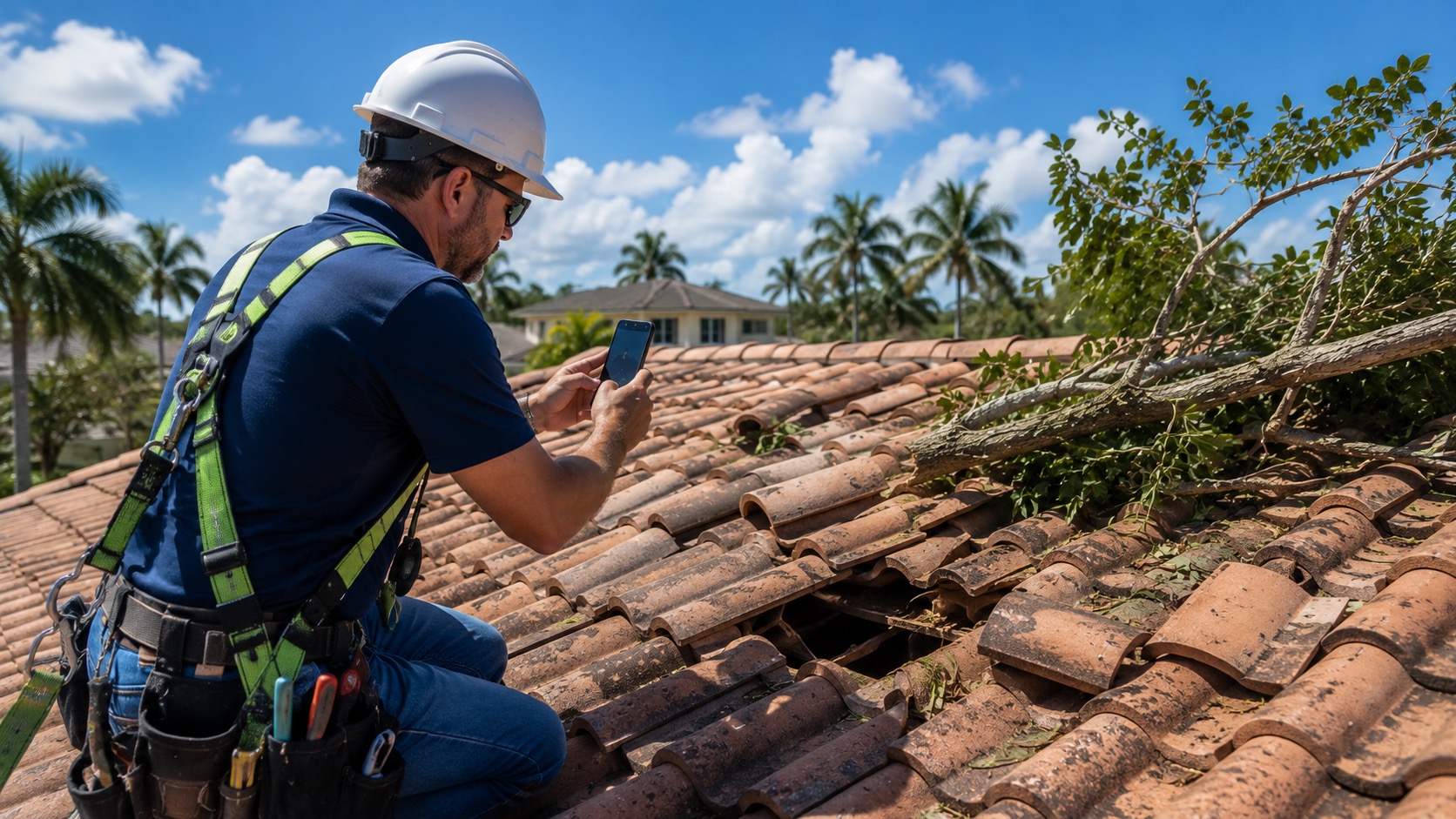
Ask them to walk the roof and show you photos of the actual problem before they recommend anything. Then ask for the NOA file numbers and the license number. A contractor confident in their honesty hands all of it over without hesitating. The hesitation is the answer.
Want the short version? The eight checks above are laid out as a printable scorecard, with our own facts filled in, at How to compare roofing companies in Miami.
Doing your homework? Good — that’s exactly the customer we want. Get a free, no-pressure estimate from a licensed (CCC1333598 · CGC1541858), insured, HVHZ-compliant contractor, with everything in writing.
Sources
- Florida DBPR — Verify a Contractor License (myfloridalicense.com) (myfloridalicense.com)
- Miami-Dade County — Product Control (NOA) Search (miamidade.gov)