Updated: November 15, 2026
A wind mitigation inspection is how a Florida insurer learns what is holding your roof on. An inspector fills out one state form, and your insurer uses it to set the windstorm credits on your policy. Below: what the form asks, who can sign it, how long it lasts and how the credits work.
What is a wind mitigation inspection?
It is an inspection of the features that help a house resist hurricane wind, recorded on the Uniform Mitigation Verification Inspection Form, OIR-B1-1802. The current version is Rev. 04/26, adopted by Rule 69O-170.0155 of the Florida Administrative Code. Inspections done on or after April 1, 2026 must use it (Citizens bulletin). The inspector needs attic access and must attach a photo or document for each feature claimed in questions 2 through 9 (OIR-B1-1802). If you are unsure whether you need this form, a 4-point or a roof certification, see 4-point vs. wind mitigation vs. roof certification.
What does the OIR-B1-1802 form check?
The form has nine questions. Three set the context: the building code in force when the house was permitted, the wind region (Miami-Dade and Broward are the High-Velocity Hurricane Zone) and the roof slope. The other six are the features that earn credits:
| Form section | What the inspector records | What scores best on the form |
|---|---|---|
| Roof covering | Each covering type, with its permit application date or FBC/Miami-Dade product approval number | All coverings meet the FBC with a product approval current at installation, or were permitted on or after 3/1/2002 |
| Roof deck attachment | The weakest deck fastening found | Concrete deck, or 7/16” plywood/OSB with 8d nails at 6” in the field (182 psf uplift) |
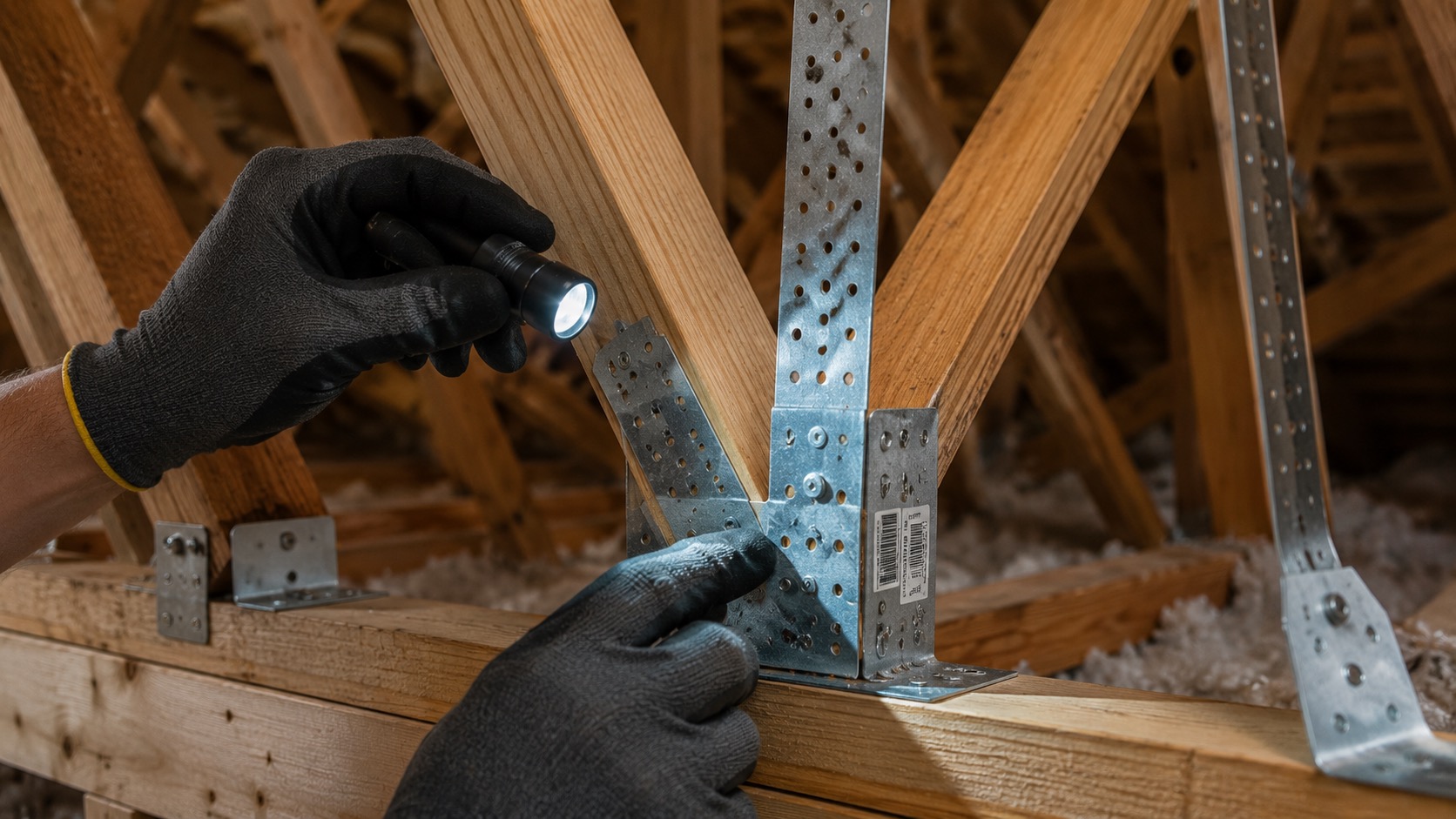
| Roof-to-wall attachment | The weakest truss or rafter connection | Double wraps, or structural anchor bolts / concrete roof |
| Roof geometry | Hip, flat or “other” | Hip roof, with non-hip features under 10% of the roof perimeter |
| Secondary water resistance | Whether the deck is sealed below the covering | Sealed roof deck (adhered membrane, taped seams, double underlayment or spray foam) |
| Opening protection | The weakest protection on any window, door, skylight or garage door | Level A: tested for cyclic pressure and a 9-lb large missile |
Source: OIR-B1-1802 (Rev. 04/26).
How does each roof section work?
Roof covering. The inspector lists every covering on the house and proves when it went on, with a permit application date or a product approval number. If any covering lacks that proof, the answer drops to C or D. Keep your roofing permit and product approval (NOA) numbers on file.
Roof deck attachment. The form grades the nailing that holds the plywood to the trusses. Level A is staples or 6d nails at 6” on the edges and 12” in the field. Level B is 8d nails at 12” in the field. Level C is 8d nails at 6” in the field. The inspector records the weakest pattern found, so one old section can set the grade for the whole roof.
Roof-to-wall attachment. This is the connection between each truss and the wall below: toenails, clips, single wraps or double wraps. The current form also accepts purpose-made connectors by documented uplift capacity: 386 lb for clips, 535 lb for single wraps and 891 lb for double wraps. Again, the weakest connection counts, except for hip and valley jacks within five feet of a corner.
Roof geometry. A hip roof qualifies when other roof shapes make up no more than 10% of the total roof perimeter. Porch and carport roofs attached only to the fascia or wall are left out of the measurement.
Secondary water resistance (SWR). This is a layer that keeps water out if the covering blows off. The form is explicit that standard underlayment and hot-mopped felts do not qualify. Qualifying options are a fully adhered underlayment meeting ASTM D1970, self-adhering tape at least 3.75 inches wide over the deck seams, two layers of approved felt or synthetic, or spray foam.
Does opening protection matter for a roof credit?
It is a separate credit, but it can affect the whole form. The question rates the weakest protection on every window, door, skylight and garage door. The form also states that a house with openings needing replacement does not qualify for wind mitigation rate differentials, regardless of the other features (OIR-B1-1802). A cracked impact window or a damaged garage door is worth fixing before the inspection.
Who can sign the form?
Under s. 627.711(2), Florida Statutes, insurers must accept the form when it is signed by one of these:
- a home inspector licensed under s. 468.8314 who has completed the required hurricane mitigation training and a proficiency exam;
- a building code inspector certified under s. 468.607;
- a general, building or residential contractor licensed under s. 489.111;
- a professional engineer licensed under s. 471.015;
- a professional architect licensed under s. 481.213;
- any other person or entity the insurer recognizes as qualified.
Signers must inspect personally, except that licensed contractors and engineers may send a qualified direct employee and remain responsible for the work. You also sign, confirming the inspection happened. Knowingly submitting a false form to get a discount is a first-degree misdemeanor under s. 627.711.
How long is a wind mitigation form valid?
The form says it is “valid for up to five (5) years provided no material changes have been made to the structure or inaccuracies found on the form” (OIR wind mitigation resources). A new roof, straps or impact openings are material changes, usually for the better, so get a new form once the work passes inspection. Citizens says it will still accept the older Rev. 01/12 form if the structure has not changed and the inspection was done within the five years before April 1, 2026 (Citizens). Other insurers may set their own rules, so ask your agent.
How do the insurance credits work?
Florida law requires residential property rate filings to include “actuarially reasonable discounts, credits, or other rate differentials” for features that reduce windstorm loss, including roof strength, roof covering, roof-to-wall strength and opening protection (s. 627.0629). Three practical points follow:
- The credits apply only to the windstorm coverage of your policy, not the whole premium. The Department of Financial Services also notes that mitigation can make you eligible for a lower hurricane deductible (DFS consumer guide).
- Your insurer must show you the range. Insurers must send a notice of the available discounts with each new policy and at every renewal (s. 627.711(1)) and post their mitigation discounts on their website (s. 627.0629).
- Newer homes start ahead. The DFS guide says homes built to the 2001 Florida Building Code or later, including homes built under the 1994 South Florida Building Code in Miami-Dade and Broward, are eligible for a minimum 68% discount on the windstorm portion of the premium.
To claim the credits, give the signed form to your agent and ask for the policy to be re-rated. If an agent or insurer won’t accept a properly completed form, the OIR points you to the DFS Division of Consumer Services at 1-877-693-5236.
Does a roof replacement improve the form?
Often, yes. For site-built single-family homes built before the Florida Building Code took effect, s. 553.844 requires a roof replacement to include a secondary water barrier and strengthened roof-deck attachment. In the wind-borne debris region, homes insured (or valued) at $300,000 or more must also get roof-to-wall improvements, if the gable ends or corners can be done for about 15% of the reroof cost. Each of those maps to a section of the form, so schedule the new inspection after the roof passes final inspection. See our roof replacement service.
Can My Safe Florida Home pay for the inspection or upgrades?
My Safe Florida Home, run by the Department of Financial Services, offers free wind mitigation inspections for site-built, owner-occupied single-family homes with a homestead exemption. Grants can fund the recommended roof and opening upgrades. Under s. 215.5586, the home must have been built before January 1, 2008 and insured for $700,000 or less, income limits apply, and the state pays $2 for every $1 from the homeowner, up to $10,000, for permitted work by licensed contractors. Funding depends on the Legislature, so check the site for current status.
Replacing your roof or just want the wind-mitigation paperwork handled right? Get a free estimate. We build to HVHZ code and hand you everything your insurer needs.
Sources
- Florida OIR — Uniform Mitigation Verification Inspection Form, OIR-B1-1802 (Rev. 04/26) (floir.gov)
- Florida OIR — Wind Mitigation Resources (floir.gov)
- Florida OIR — Premium Discounts for Hurricane Loss Mitigation (floir.gov)
- Florida Statutes 2026, § 627.0629 — Residential property insurance; rate filings (flsenate.gov)
- Florida Statutes 2026, § 627.711 — Notice of premium discounts for hurricane loss mitigation; uniform mitigation verification inspection form (flsenate.gov)
- Florida Statutes 2026, § 553.844 — Windstorm loss mitigation; requirements for roofs and opening protection (flsenate.gov)
- Florida Department of Financial Services — Premium Discounts for Hurricane Loss Mitigation: A Guide for Consumers (July 2026) (myfloridacfo.com)
- Citizens Property Insurance — Uniform Mitigation Verification Inspection Form Changes (March 19, 2026) (citizensfla.com)
- My Safe Florida Home — Florida Department of Financial Services (mysafeflhome.com)
- Florida Statutes 2026, § 215.5586 — My Safe Florida Home Program (flsenate.gov)