Updated: November 15, 2026
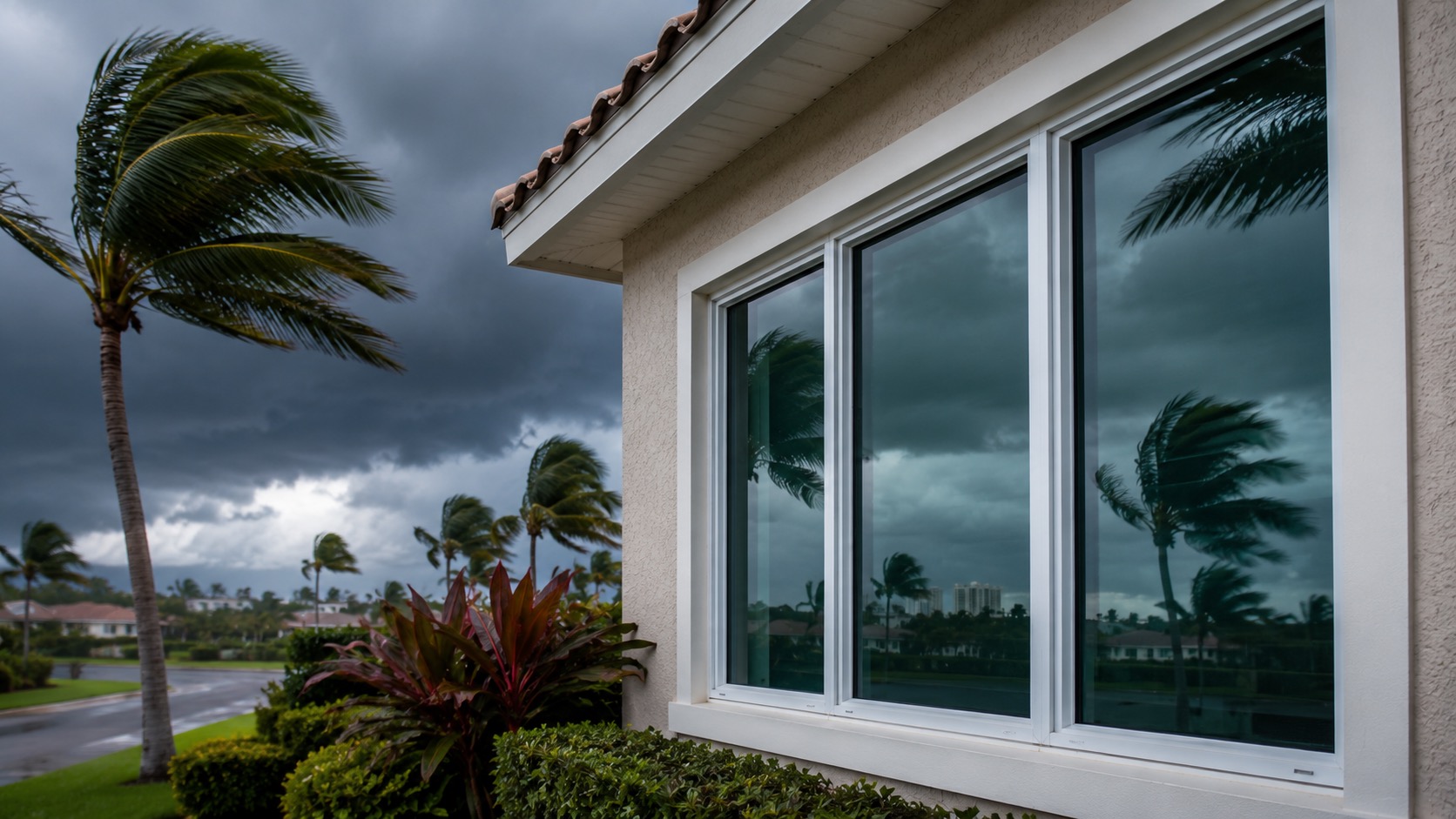
A house rides out a hurricane best when its envelope stays closed. A broken window or a garage door blown in lets wind inside, and FEMA warns that wind coming in through an opening that large can “pose grave problems for the rest of your home,” above all the roof (FEMA). Impact windows and doors are one way to keep openings closed. Tested shutters are the other. This page compares the two and covers what they mean for insurance, grants and the roof.
What does an impact window do in a storm?
Impact glass is laminated: two or more panes bonded to a plastic interlayer. FEMA’s mitigation handbook explains that the glass “may be broken by wind-borne debris, but the interlayer will remain intact to prevent wind and wind-driven rain entry.” It adds that laminated glazing “may increase the energy efficiency of the building” (FEMA P-2181, 3.2). The frame, anchors and design pressure rating matter as much as the glass, which is why each product carries a tested approval.
Doors count too. FEMA calls garage doors “one of the largest openings in a building,” vulnerable to being blown in, pulled out or twisted off their tracks. Its homeowner advice is to replace old garage doors and tracks “with a door that is approved for both wind pressure and impact protection.” A house with impact windows and an unrated garage door still has a weak point.
Impact windows or shutters?
Both protect the glass when they are tested and installed correctly. The difference is who has to act before the storm.
| Impact windows and doors | Tested storm shutters | |
|---|---|---|
| How it protects | Always in place | Only once closed or installed |
| Before a storm | Nothing to do | Someone has to deploy them, and FEMA notes upper floors may need equipment |
| Wind mitigation form | Can qualify for the top level (A) if verified | Can also qualify for A or B if verified |
| What to check | Product approval, design pressure, anchoring | Label showing it was “tested and is building code compliant” (FEMA) |
| Daily life | Normal windows | Stored panels or permanent tracks and housings |
FEMA describes shutter deployment as “an active mitigation measure that requires manual installation, so adequate time must be available before the storm” (FEMA P-2181, 3.2). If you travel in hurricane season, rent the house out or can’t safely climb a ladder, that line decides it. If someone is always home and the budget is tight, tested shutters on some openings and impact units on others is a common mix. Get installed quotes for both on your actual openings.
What should the product carry in Miami-Dade?
In Miami-Dade and Broward, every window, door and shutter needs a current approval valid for the High-Velocity Hurricane Zone: a Miami-Dade Notice of Acceptance (NOA) or a Florida Product Approval marked for HVHZ use. A typical window NOA lists the HVHZ test protocols it passed, including large- and small-missile impact (TAS 201), air, water and static pressure (TAS 202) and cyclic wind pressure (TAS 203) (NOA 26-0715.07).
The approval also limits size and design pressure, and its drawings set the anchoring. The rated pressure at your window’s size has to meet the pressure required for that opening. Our NOA and product approval guide shows how to look up any approval and what to check on the label before final inspection.
Is opening protection ever required on an existing home?
In one specific case, yes. Florida law requires opening protection, built to the code for new construction, when a site-built single-family home in the wind-borne debris region gets permitted work estimated at $50,000 or more, and the house has an insured value (or, if uninsured, a just valuation) of $750,000 or more. Roof covering replacement and repair work is excluded from that trigger (s. 553.844(3)(c), F.S.). Ask your building department how it applies to a larger renovation.
How do impact openings affect insurance?
Florida law requires insurers’ rate filings to include “actuarially reasonable discounts, credits, or other rate differentials” for features that include “opening protection, and window, door, and skylight strength” (s. 627.0629, F.S.). The credit is documented on the state’s wind mitigation form.
That form’s opening protection question asks for the “WEAKEST form of wind-borne debris protection installed on the structure,” and it counts windows, doors, sliding glass doors, skylights and garage doors. Level A means every glazed opening is protected by products verified for cyclic pressure and the 9-lb large missile, under Miami-Dade TAS 201, 202 and 203, ASTM E1886 and E1996, or SSTD 12, with ANSI/DASMA 115 for garage doors. Level C is plywood or OSB panels meeting the 2007 code. If even one glazed opening is unprotected, the answer drops to X. Damaged openings needing replacement disqualify the house from these credits (OIR-B1-1802). Doing every window but skipping the garage door or front door can cost you the result you paid for. How much you save is set by your carrier. See what a wind mitigation inspection looks at.
Can My Safe Florida Home help pay for it?
Possibly. The state program offers free wind mitigation inspections and grants of up to $10,000 for improvements such as impact windows and doors, garage door reinforcement and roof upgrades (My Safe Florida Home). Under the statute as amended in 2026, a grant applicant must have a homestead exemption, a home built before January 1, 2008 with an insured value of $700,000 or less, a program inspection within the prior 24 months, and must qualify as low- or moderate-income. Grants are matched $1 from the owner for every $2 from the state, up to $10,000 in state money. Low-income applicants can receive up to $10,000 with no match (s. 215.5586, F.S.).
Two details matter. The work must be recommended by the initial inspection and confirmed by the final one, and the program can require improvements to all openings. The 2026 amendments are set to expire July 1, 2027, so check current rules and funding on the program’s site before you sign a contract.
Are they worth it for your house?
Impact windows and doors make the most sense when:
- Nobody can reliably deploy shutters before every storm.
- You can protect every opening, garage door included, and reach the top level on the wind mitigation form.
- You plan to stay long enough for the insurance credit and daily use to matter.
- The house qualifies for a My Safe Florida Home grant.
Manufacturers also market noise reduction and UV filtering. Ask for the tested data on the specific product rather than relying on the brochure.
Plan the openings with the roof
The roof and the openings make one envelope. When you replace a roof in Florida, the law already requires a secondary water barrier and better roof-deck attachment. In the wind-borne debris region, homes insured for $300,000 or more also get roof-to-wall connections, when that work can be done at the gable ends or corners for no more than 15 percent of the roof replacement cost (s. 553.844, F.S.). Doing openings and the roof in the same window lets one wind mitigation inspection capture both. Our hurricane season roof checklist covers the roof side.
Next step
Make a list of every opening, garage door and skylights included, and get one quote that covers all of them with the approval number for each product. Art’s Roofing & Construction (Certified General Contractor CGC1541858) installs impact windows and doors across Miami-Dade, Broward and Palm Beach. See our impact windows and doors service or request a free estimate.
Sources
- FEMA P-2181 Fact Sheet 3.2 — Wall Systems and Openings (March 2022) (fema.gov)
- FEMA — Tips to Prepare Your Home for Hurricane Season (fema.gov)
- Florida OIR — Uniform Mitigation Verification Inspection Form OIR-B1-1802 (Rev. 04/26) (floir.gov)
- Florida Statutes (2026) s. 627.0629 — Residential property insurance; rate filings (flsenate.gov)
- Florida Statutes (2026) s. 215.5586 — My Safe Florida Home Program (flsenate.gov)
- My Safe Florida Home — Florida Department of Financial Services (mysafeflhome.com)
- Florida Statutes (2026) s. 553.844 — Windstorm loss mitigation; requirements for roofs and opening protection (flsenate.gov)
- Miami-Dade Notice of Acceptance No. 26-0715.07 (aluminum single-hung window, L.M.I.), approved Aug. 20, 2026 (miamidade.gov)